
How do I complete the CA Dept of Health CNA and Home Health Aide live scan requirement in Los Angeles?
If you need a CA Dept of Health – Certified Nurse Assistant and Home Health Aide live scan in Los Angeles, start by confirming you have the correct CDPH Request for Live Scan Service form for your pathway. Do not use a random form from the internet or a form borrowed from a friend. The ORI code routes the submission to CDPH, but the applicant type selected under that ORI helps connect your fingerprints to the correct CNA, Home Health Aide, or related CDPH pathway.
Next, fill in your personal information carefully before your appointment and match your government ID exactly. Most matching issues come from small differences in name formatting, date of birth typos, or leaving fields blank. Bring valid ID and a payment method, complete the scan, then review your receipt before leaving.
Finally, keep your proof. Your ATI number is your tracking reference. If your application file ever shows “missing fingerprints” or “pending clearance,” the ATI number is usually the fastest way to confirm the submission and help the program match it to your file without rescanning.
Schedule a California Live Scan appointment.
Why this is not “just getting fingerprinted”
A lot of applicants search “live scan near me,” book the first available slot, and assume their prints automatically go to the right place.
That is the most common mistake.
Live Scan is a routing system. Your fingerprints do not simply “go into the system.” They are transmitted to a specific agency lane based on the routing information the operator enters, and that routing information comes from your Request for Live Scan Service form.
Think of your form like a shipping label.
If the label is correct, the package arrives at the right destination.
If the label is wrong, the package can still ship, but it arrives somewhere else.
In CDPH-related workflows, “I did Live Scan” only matters if the submission was routed using the correct CDPH form and the correct ORI code. A perfectly captured scan routed to the wrong ORI can leave your application stuck, even though you paid and have a receipt.
This is also why a prior Live Scan for a different job, a school requirement, a volunteer role, or another license usually does not transfer. It may have been routed to a completely different agency lane.
Who typically needs this Live Scan for CDPH CNA or HHA
Most people who need a CA Dept of Health – Certified Nurse Assistant and Home Health Aide live scan fall into one of these situations.
You are applying to become a CNA in California and fingerprints are part of your clearance requirement.
You are registering as a Home Health Aide and fingerprints are required as part of your registration process.
You already hold one credential but are adding another and your instructions require a new submission.
You were instructed by the program or your checklist to complete Live Scan using a specific CDPH request form.
The exact scenario can vary, but the submission rule is the same.
If your instructions provide a CDPH Request for Live Scan Service form, you must submit fingerprints using that form’s routing details.
If you do not have the form, do not guess. Getting the correct form first is the most time-saving move you can make.
CNA vs Home Health Aide: why the routing still matters
Applicants sometimes assume CNA and Home Health Aide are “basically the same,” so any health-related Live Scan should count.
In reality, the requesting program matters.
Different programs can use different routing details, different internal identifiers, or different processing lanes. That does not mean the fingerprint scan is different. It means the submission label is different.
So if you are applying for CNA and HHA together, or you are adding one after the other, follow the instructions for each step and make sure the request form you are using matches the program requirement you are currently fulfilling.
This is a common place where delays happen.
An applicant uses the wrong request form, completes the scan, and later learns the results were routed under a different program lane. They end up rescanning when a simple form check could have prevented it.
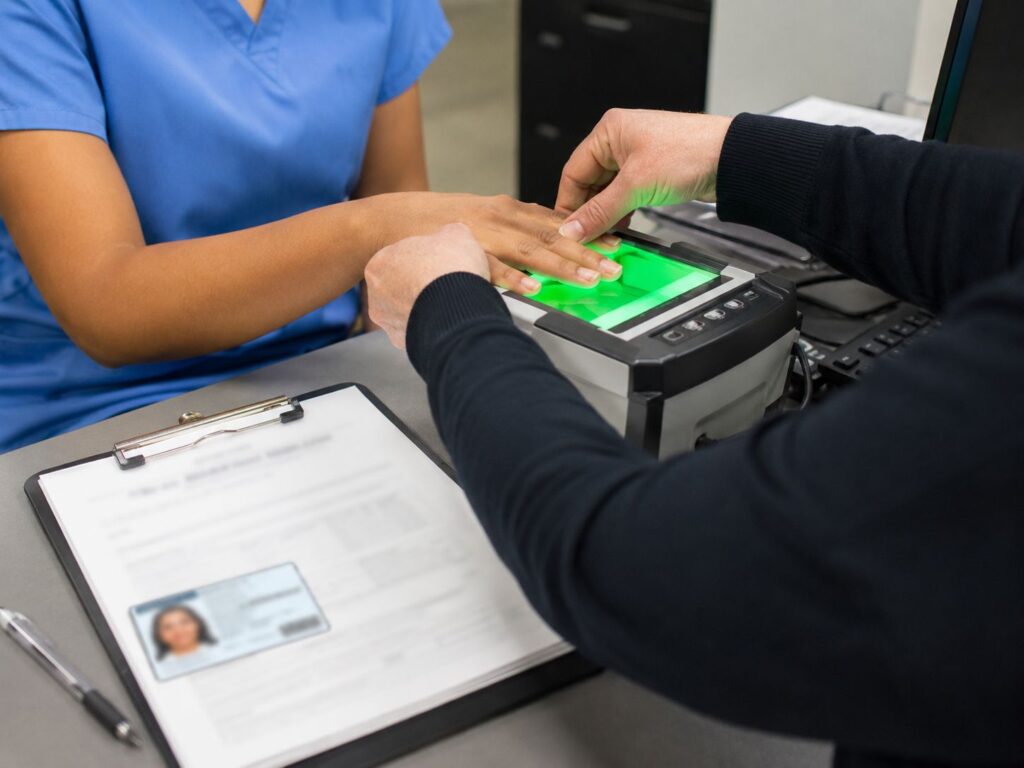
DOJ review level fingerprinting vs FBI review level (if required) for CDPH submissions
Applicants often say, “I just need a background check.” The problem is that Live Scan submissions can be configured for different levels of service.
Here is the practical distinction.
DOJ fingerprinting is tied to California’s system and California record checks.
FBI live scan (if required) adds a federal record check component.
Some programs require both because they want broader coverage.
The key point is this.
You should not guess which level is required.
The CDPH CNA and Home Health Aide program includes multiple applicant types under the same ORI code. Although these applicant types use California DOJ-level review, selecting the correct applicant type still matters because it helps CDPH match the submission to the correct certification or registration pathway.
Your Request for Live Scan Service form identifies the correct applicant type for your certification or registration pathway, and the operator enters that applicant type when submitting your fingerprints under the CDPH ORI code. Although these applicant types generally use California DOJ-level review, selecting the wrong applicant type can still delay processing because your fingerprints may not be matched to the correct CDPH program. Always use the Request for Live Scan Service form issued for your own application rather than assuming another person’s form is interchangeable.
If you are also dealing with a separate federal record requirement for another license application, please consult your agency and if required, use FBI background check support.
The CDPH Request for Live Scan Service form is the control panel
Most people think the fingerprint scan is the important part.
In CDPH submissions, the form is the important part.
The operator is not choosing where your results go based on your story. They are entering what the form tells them to enter.
That means your CA Dept of Health – Certified Nurse Assistant and Home Health Aide live scan is only as good as:
The form you brought
The ORI code on that form
The level of service on that form
The accuracy of your personal details
Your proof and tracking after submission
If any of these is wrong, you can end up in the rescan loop.
You do not want that loop, because it wastes time and money and delays your file.
The fields that cause the most delays
When CDPH fingerprint submissions get stuck, it is usually one of the same predictable issues.
Fix these, and you remove most preventable delays.
ORI code
The ORI code is the routing address. It tells the Live Scan system where to transmit your results.
Even one wrong character can route the submission away from the correct lane.
- Do not copy an ORI code from a screenshot.
- Do not borrow a friend’s form.
- Do not use a saved form from an old application unless you are sure it is the current form required for your pathway.
Use only the ORI code printed on your current CDPH request form.
If you are unsure whether your form is current, get the latest version through the official instructions tied to your CNA or HHA pathway.
Requesting agency and any program identifiers
Many request forms include internal fields such as an agency name line, a mail code, or a program label. These fields can help the receiving agency match results to the correct internal queue.
If your CDPH form includes prefilled program identifiers, do not change them.
If the form instructs you to leave something blank, leave it blank.
If the form instructs you to fill a field, fill it clearly.
A common mistake is “cleaning up” a form by changing prefilled routing fields. That can break matching.
Applicant information
Your personal information must match your government ID.
This is a big delay trigger because people do not realize how sensitive matching can be.
Common mismatch patterns include:
Using a nickname on the form
Leaving out a middle name that appears on the ID
Reversing two last names
Removing a hyphen from a hyphenated name
Spacing differences in multi-part names
Date of birth typo
If you want your submission to match fast, fill the form to match the ID you will present at the appointment, unless your instructions explicitly say otherwise.
Level of service
Applicant type
The applicant type selected under the CDPH ORI code helps identify the correct CNA, Home Health Aide, or related certification pathway. Even though these applicant types generally use California DOJ-level review, selecting the wrong applicant type can still delay processing or matching.
• Do not assume another applicant’s form is the same as yours.
• Do not substitute a different applicant type because it sounds similar.
• Always use the applicant type shown on your own Request for Live Scan Service form.
ATI number
The ATI number is your tracking reference and proof.
If there is ever a question about whether your CA Dept of Health – Certified Nurse Assistant and Home Health Aide live scan was submitted, the ATI number is usually the fastest way to confirm the submission and help locate it.
Before you leave your appointment, confirm the ATI number is printed and readable.
Take a clear photo of it as backup.
Save the scan date and location with it.
Leaving without the ATI number is one of the easiest ways to end up rescanning later.
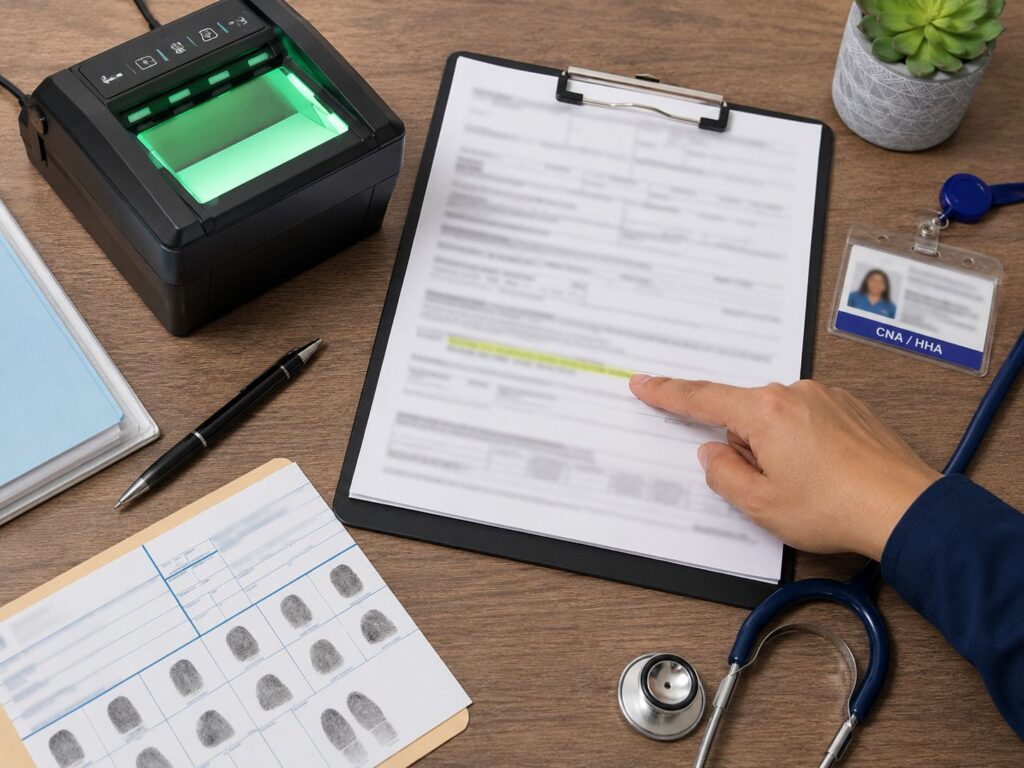
Step-by-step: CA Dept of Health CNA and HHA Live Scan in Los Angeles
This is the process that works when you want to do it once and avoid rework.
Step 1: Confirm you have the correct CDPH request form for your pathway
Use the Request for Live Scan Service form tied to your CNA or HHA requirement.
Check that the form:
Clearly identifies the requesting agency or program
Includes an ORI code
Indicates the level of service
Has any required prefilled fields intact
If you are applying for both CNA and HHA and your instructions provide different forms or different routing, do not assume you can use one form for both. Follow the pathway instructions.
If you do not have the form, do not guess. Get it first.
Step 2: Fill your personal fields before you arrive
Complete your personal information at home when you are not rushed.
Use your legal name exactly as shown on your ID.
- Double-check spelling.
- Double-check date of birth.
Write legibly.
This prevents the most common “typo delays.”
If your name includes multiple parts, keep spacing consistent. If you recently changed your name, keep the submission consistent with the ID you will present unless your instructions specify otherwise.
Step 3: Bring valid government ID and payment
Bring a valid government photo ID.
If your ID is expired, do not assume it will be accepted.
Bring your payment method. Live Scan totals often include a rolling fee plus any government fees tied to your submission level of service.
Do not show up assuming a single flat fee. Fees vary depending on the program.
Step 4: Hand the operator the CDPH form and confirm the purpose
Do not treat the appointment like a generic scan.
Hand the operator your CDPH request form and confirm it is for your CNA or HHA submission.
This reduces routing mistakes, especially in busy locations that process many different agencies every day.
The operator should enter the ORI code and level of service exactly as printed on the form.
Step 5: Complete the scan, then review the receipt before leaving
Before you leave, check three things.
- Your name is correct.
- Your date of birth is correct.
- Your ATI number is printed and readable.
If anything is wrong, fix it immediately. Fixing a typo at the counter is easier than trying to fix it after submission.
Take a clear photo of your receipt or completed form with the ATI number visible.
Step 6: Follow any proof instructions tied to your pathway
Some programs only require electronic transmission.
Other pathways may require you to upload, attach, or mail a copy of the receipt or completed form.
Follow your checklist. Even if proof is not required, keep your copy.
Keeping proof protects you if a matching issue appears later.
Quick reference table
| Scenario | What you should do | What you must have | What you should keep | Most common delay |
| In California with the correct CDPH form | Complete Live Scan using the CDPH routing | Printed CDPH form, valid ID, payment | Receipt or form copy with ATI number | Wrong ORI or applicant info typos |
| Submission appears missing or unmatched | Provide ATI number and scan date to help match | ATI number, scan date, scan location | Photo of ATI number and receipt | No ATI number, wrong routing, name mismatch |
| Out of state applicant | Follow fingerprint card lane if instructed | Correct card instructions, correct card type | Mailing proof and tracking | Wrong card format, poor prints, incomplete packet |
| Form requests DOJ plus FBI | Submit exactly as requested | Form showing DOJ plus FBI | ATI number | Submitting DOJ only |
| Name changed recently | Keep submission aligned with current ID | ID and form fields consistent | Supporting proof if required by instructions | Manual matching delays |
Conditional requirements
This section is written to mirror the real reasons CNA and HHA applicants get delayed.

If you are in California
This is usually the simplest lane.
Electronic transmission is faster than paper.
Your biggest risk is routing mistakes, not scan quality.
Use the correct CDPH form, confirm the ORI code, follow the form’s level of service, and keep your ATI number. Those four actions remove most preventable delays.
If you are out of state
Live Scan is a California system. If you are outside California, your instructions may direct you to fingerprint cards instead.
Card-based submissions usually take longer for predictable reasons.
Mailing time adds delay.
Ink quality can trigger rejection.
Incomplete cards can trigger resubmission.
Manual processing can take longer than electronic submissions.
If your pathway requires fingerprint cards, see fingerprint card options for out-of-state applicants.
If you are in this lane, plan buffer time. Do not wait until the last week.
If you need a flexible or on-site appointment
Some applicants prefer a location-based option due to schedule, transportation, or mobility.
That does not change routing.
You still need the CDPH request form.
You still need the ORI code.
You still need to keep the ATI number.
If that fits your situation, learn more about our mobile fingerprinting option.
If you have a recent name change or name mismatch
Name mismatch is a quiet delay that surprises people.
Even when your submission is routed correctly, matching to the correct file can slow down if your application name, your ID name, and your submission name do not align.
If your name changed recently, keep your submission consistent with your current government ID unless your instructions require a different format.
If your checklist requires a supporting statement for name consistency, handle it early.
If notarization is required for any supporting statement, use book a notary appointment.
If you previously completed Live Scan for another job or program
Do not assume it transfers.
A prior Live Scan routed to a different ORI does not automatically satisfy a CDPH CNA or HHA requirement.
This is one of the most common reasons applicants hear “we don’t have your fingerprints,” even though they completed a scan.
The fix is not arguing that you did Live Scan. The fix is confirming that the receipt and request form match CDPH routing for your pathway.
If your application involves multiple individuals
Some health-related workflows involve multiple individuals, such as owners, administrators, or other specified roles, depending on the program.
If multiple people must submit prints, keep each person’s packet separate.
One form per person.
One ID per person.
One receipt per person.
Keep each ATI number tied to the correct person.
Mixing receipts among multiple people is an easy way to create matching delays.
Common mistakes that cause CNA and HHA Live Scan delays
Most delays come from the same avoidable errors.
Using the wrong form or an old form version.
Copying an ORI code from a screenshot.
Changing prefilled routing fields.
Selecting the wrong level of service.
Typos in name or date of birth.
Leaving without the ATI number.
Assuming a prior Live Scan submission transfers.
Waiting too late and losing buffer time.
Mixing proof among multiple individuals.
If you want the cleanest submission, focus on preventing these mistakes. They are simple, but their consequences can be big.
What to bring to your Los Angeles appointment
Printed CDPH Request for Live Scan Service form
Valid government photo ID
Payment method
A pen for clean corrections if needed
A simple habit that saves time later is taking a clear photo of your completed form and receipt showing the ATI number before you leave.
What happens after you submit
After your CA Dept of Health – Certified Nurse Assistant and Home Health Aide live scan is completed, results typically transmit electronically. Processing and matching happen on the program side according to their internal workflow.
Your job is mostly done once you submit correctly and keep proof.
If your checklist requires you to upload or attach proof, do it promptly so your file is not paused for a missing document.
If follow-up is needed, having your ATI number and scan date makes resolution much faster.
How to avoid the “I did Live Scan but they can’t find it” situation
This is the most frustrating outcome, and it usually comes down to one of these causes.
- Wrong ORI or wrong routing was used.
- Wrong level of service was selected.
- Applicant information did not match the file.
- The applicant cannot provide an ATI number to help match the submission.
- The prevention steps are simple.
- Use the correct CDPH request form.
- Review the ORI and level of service before submission.
- Match the form to your ID.
- Keep the ATI number and scan date.
If you do those, most missing-results issues become quick to resolve instead of a rescan event.
A quick check now can save you a full redo later. Confirm you have the correct CNA or Home Health Aide request form, confirm the ORI code and level of service match what the form requires, and make sure your name and date of birth match your ID exactly. After your scan, save your receipt with the ATI number. Those steps prevent most delays and reduce the chance you will need to resubmit.
FAQs
What is the ORI code and why does it matter for CNA and Home Health Aide Live Scan?
The ORI code is the routing address that tells Live Scan where to send your results. If it’s entered incorrectly, your results can be routed to the wrong destination even if the scan was completed successfully.
What is the ATI number?
The ATI number is the tracking reference printed on your Live Scan receipt. It helps locate your submission if your application shows pending or if you’re told results were not received.
What should I bring to a CNA or Home Health Aide Live Scan appointment?
Bring the Request for Live Scan Service form for your requirement, a valid government photo ID, and your payment method. After the scan, keep your receipt with the ATI number and save a photo of it.
Why does the applicant type matter if the ORI code stays the same?
The CDPH CNA and Home Health Aide program uses the same ORI code, but it includes multiple applicant types under that ORI. The Live Scan operator must select the applicant type that matches your Request for Live Scan Service form. Although these applicant types generally use California DOJ-level review, selecting the wrong applicant type can delay processing or prevent your fingerprints from being matched to the correct certification or registration pathway.
Can I reuse a previous Live Scan submission for CNA or Home Health Aide requirements?
Usually not. Live Scan submissions are routed by agency and purpose. A prior submission for a different program may not satisfy this requirement if the ORI and routing were different.
What causes the most common delays?
The most common delays are using the wrong form, ORI routing errors, selecting the wrong level of service, name or date-of-birth mismatches, and not saving the ATI receipt proof.
Do I need to send my receipt to anyone?
Some programs request proof and some rely on electronic transmission only. Even if you’re not asked to upload the receipt, keep it with the ATI number in case follow-up is needed.