What is the ORI code for a Community Care Licensing Live Scan?
Community Care Licensing submissions route under ORI A0448, on form LIC 9163. The ORI is what sends your results to Community Care Licensing. If it is entered incorrectly, your fingerprints transmit successfully and CCL still receives nothing.
Where your facility has its own OCA number assigned to it, that number belongs on the form as well.
Which form do you need — IHSS or Community Care Licensing?
Caring for your mother, father, or another relative in their home? That is IHSS. Your form comes from PASC, the Personal Assistance Services Council, and it routes to them. PASC is explicit in its own instructions: use only the form they provide, complete it in triplicate, and if you do not, PASC never receives your results and you pay to be fingerprinted again.
Working at a licensed care facility — assisted living, adult residential, adult day? That is Community Care Licensing. Different agency, different form. Where your facility has its own OCA number assigned to it, that number belongs on this form.
These two get mixed up constantly, and the IHSS form is usually the culprit because it looks generic. It is not. Bring the wrong one and the scan still happens — your results simply go nowhere.
How do I complete the community care licensing live scan requirement in Los Angeles?
If you need a community care licensing live scan in Los Angeles, treat it like a routed, form-driven submission, not a generic “background check.” Your fingerprints only count if the operator enters the exact routing details from your licensing request form, especially the ORI code and the correct level of service (DOJ only, or DOJ plus FBI).
The fastest way to avoid delays is simple. Use the correct Community Care Licensing request form for your exact pathway, fill your personal information to match your government ID, complete the scan, then keep your proof with the ATI number. If your file later shows “fingerprints missing” or “pending,” the ATI number is usually the quickest way to confirm your submission and help match it without rescanning.
For most California applicants, the standard lane is electronic Live Scan, and results transmit automatically once the submission is routed correctly. For out-of-state situations, some licensing pathways use fingerprint cards instead, and that lane usually takes longer because it is more manual and has more rejection points.
For scheduling in Los Angeles, use this appointment lane once: Live Scan.
Important: Community Care Licensing is not a single application. It covers many different licensing programs, facility types, and applicant roles. Although they all use Live Scan, the Request for Live Scan Service form, ORI code, and required level of background review may differ depending on your specific pathway. Always use the form issued for your application rather than copying information from another applicant.
Why this is not “any Live Scan” and why people get stuck
A lot of applicants have done Live Scan before for a job, a school district, volunteering, or another license. That experience helps, but it also creates the most common mistake.
A community care licensing live scan is agency-specific. Live Scan is a routing network. Your fingerprints do not simply “go into the system.” They are transmitted to a specific agency pipeline based on the routing information entered by the operator.
That routing information comes from your request form. The ORI code acts like an address. If the address is wrong, your prints can transmit successfully and still not land in the correct licensing pipeline.
This is why a Live Scan you did last month for a different agency usually cannot be reused for Community Care Licensing. It was likely routed under a different ORI and a different program, so Community Care Licensing may never receive it in the lane they are monitoring for your file.
So the real goal is not “get fingerprinted.”
The real goal is “submit fingerprints under the correct Community Care Licensing routing and keep proof.”
Once you treat it that way, the process becomes predictable.
Who typically needs a community care licensing live scan
People run into the community care licensing live scan requirement when they are connected to a licensed care setting or a licensing application that requires clearance. In real life, this often includes roles tied to facilities or programs overseen through Community Care Licensing.
The exact title can vary, but the pattern is the same:
- Your pathway requires fingerprint clearance.
- You are given a specific request form with routing details.
- You complete Live Scan under that routing.
- Your licensing file clears once the results match correctly.
A common delay happens when someone assumes the requirement applies only to one person. In many licensing settings, multiple individuals may need clearance, depending on the role and the program. The only safe approach is to follow the checklist for your pathway and ensure each required person completes the correct routed submission.
If you are unsure who must be printed, confirm before scheduling multiple appointments. One quick confirmation can save a week of rework.
The three things that decide whether your submission counts
If you want the “do it once” outcome, focus on these three items.
- Correct routing fields from the correct form
- Applicant information that matches the ID and the licensing file
- Proof and tracking, especially the ATI number
When Community Care Licensing says “we don’t have it,” the cause is usually one of those three failing.
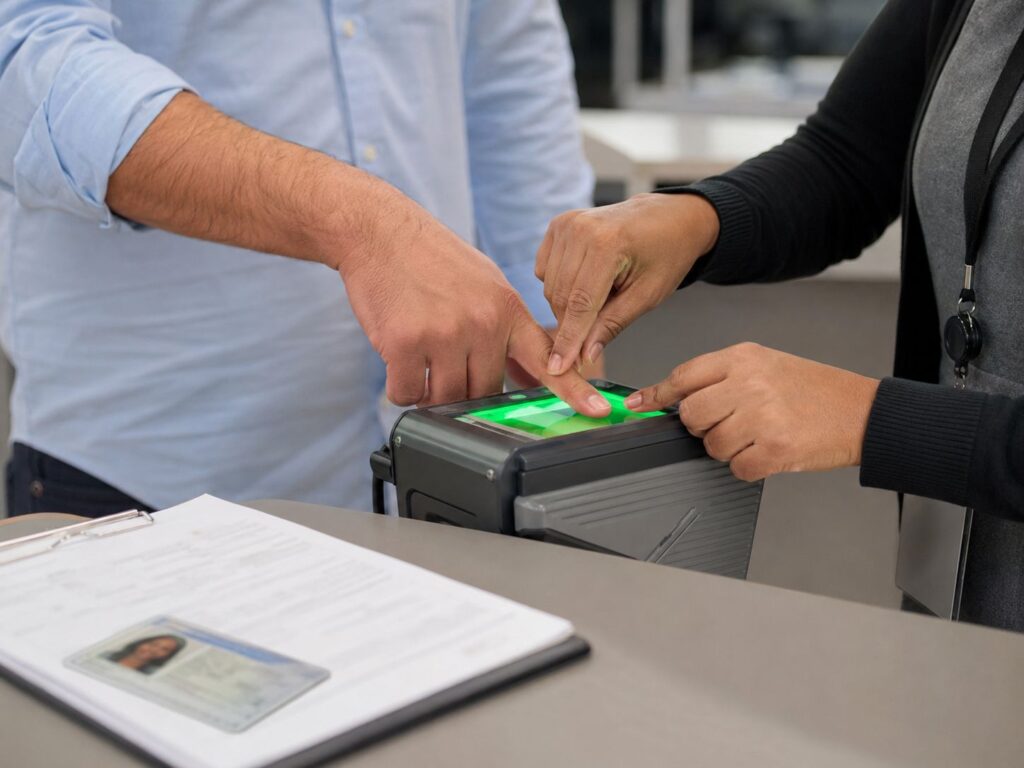
DOJ fingerprinting vs FBI checks: what it means in licensing submissions
Applicants often say “I just need a background check.” The issue is that the level of service can be configured differently, and the wrong configuration can leave the requirement incomplete.
Here is the practical distinction:
DOJ fingerprinting is tied to California’s system and California record checks.
An FBI component adds a federal record check layer.
Some programs require both for broader coverage.
For a community care licensing live scan, you should not guess what level you need. Follow what your request form requests. The operator selects the level based on the form.
Different Community Care Licensing applicant types may require different levels of background review. Depending on your role, facility type, or licensing pathway, your Request for Live Scan Service form may specify DOJ only or DOJ plus FBI. The standard LIC 9163 form uses a preprinted CCL ORI, but specialized programs may use different forms and routing information. The authorized applicant type and required services must still match the applicant’s pathway. Depending on the applicant type selected, the required level of service may be DOJ only or DOJ plus FBI. Always use the Request for Live Scan Service form issued for your own application rather than assuming another person’s form is the same. For that reason, always follow the level of service printed on your own form rather than assuming it will match someone else’s.
- If the form requests DOJ only, submit DOJ only.
- If the form requests DOJ plus FBI, submit DOJ plus FBI.
- If the form requests a CACI check, note that processing may take longer than DOJ and FBI.
If the form includes an FBI requirement, remember one key clarification: FBI checks are handled through federal channels under federal authority, not only California DOJ. That is why it matters to submit the correct level of service rather than assuming DOJ-only is always enough.
If you are dealing with a separate FBI background check for another purpose, you can learn more here FBI background check details.
The request form is the control panel
Most applicants think the scan itself is the main task. For licensing submissions, however, the request form controls where the fingerprints are sent. The California Department of Social Services Live Scan guidance specifically advises applicants to use only the form provided by their employer, licensee, or provider because it contains agency-specific information required for proper routing.
The operator is not deciding where your results go. They are entering what your request form tells them to enter. If the form is wrong, outdated, or not the form for your pathway, the submission can route incorrectly even if the scan is perfect.
Treat your form like a shipping label:
- Correct label means correct destination.
- Wrong label means wrong destination.
A community care licensing live scan that routes incorrectly is one of the most frustrating outcomes because you did the scan, you paid, and you still end up rescanning because the licensing pipeline never received it.
Form fields that cause the most delays
This section is the difference between “cleared” and “pending.”
ORI code
The ORI code is the routing address. It tells the Live Scan system exactly where to send your results.
Even one wrong character can route results away from the correct licensing lane. That leads to the classic problem where you have proof of scanning, but the licensing office says they can’t find it.
- Do not copy an ORI from a screenshot.
- Do not borrow a form from a coworker.
- Do not use a generic form you found online.
Use only the ORI code printed on the request form tied to your Community Care Licensing pathway.
Requesting agency name and program identifiers
Many request forms include internal fields like an agency label, a mail code, a billing number, or a program identifier. These fields can help the receiving unit match results into the correct queue.
- If your form has prefilled program fields, do not change them.
- If a field says “for agency use only,” leave it alone.
- If the form instructs you to fill a field, fill it clearly.
People create delays by trying to “clean up” routing fields that were intentionally prefilled.
Applicant information
This is the second biggest cause of delays after routing.
Your name and date of birth must match your government ID exactly. Small differences can slow matching or trigger manual review.
Common mismatch patterns include:
- Two last names entered in a different order
- Hyphenated name entered without the hyphen
- Middle name included on ID but omitted on the form
- Nickname used on the form instead of legal name
- Spacing differences in multi-part names
- Date of birth typo
Fill the form to match the ID you will present at the appointment unless your licensing instructions explicitly say otherwise.
Level of service
This is where DOJ-only vs DOJ-plus-FBI is decided.
- Follow the request form.
- Do not downgrade because of cost.
- Do not “add FBI” just in case.
- Do not choose what you did for a different job.
Wrong level of service is one of the fastest ways to end up rescanning.
ATI number
The ATI number is your tracking reference and proof. It is printed after the scan.
- Before you leave, confirm the ATI number is printed and readable.
- Take a clear photo of the receipt.
- Save the scan date and location with it.
Losing the ATI number is how people get stuck, because they cannot prove what was submitted and the licensing office cannot quickly match the submission.
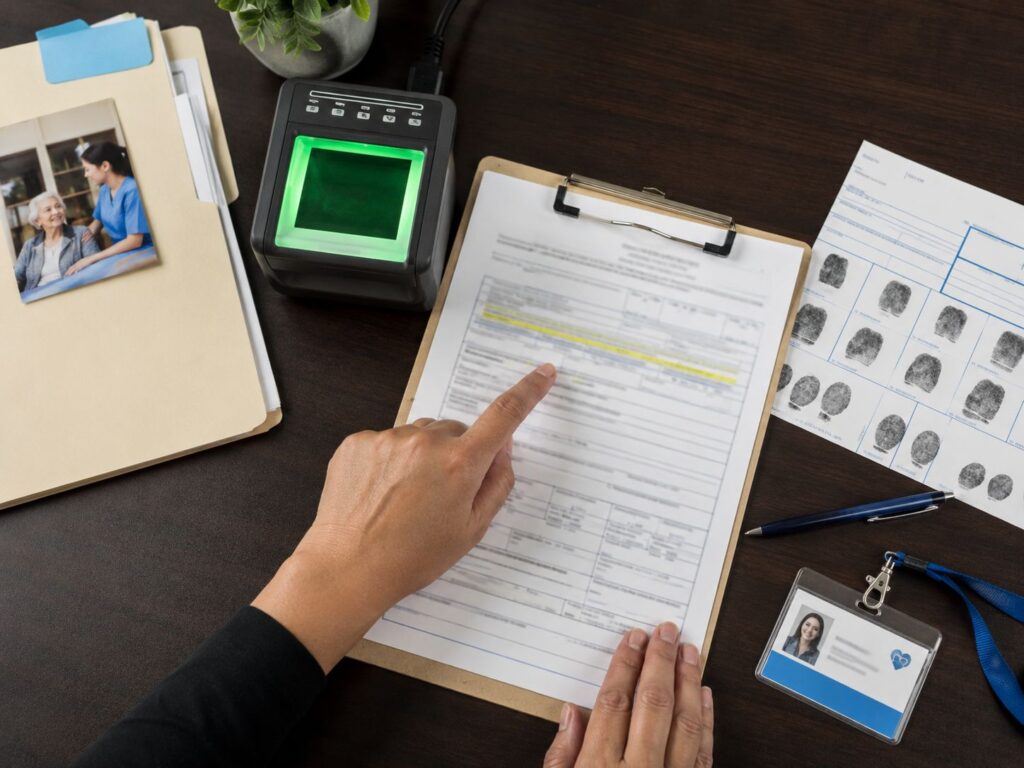
Step by step: community care licensing live scan in Los Angeles
This sequence is designed to prevent rework.
Step 1: Confirm you have the correct request form for your pathway
Use the request form tied to your Community Care Licensing requirement.
Make sure it includes:
- The correct program or requesting unit label
- An ORI code
- A specified level of service
- Any prefilled internal fields intact
If you are handed a form that looks generic, or you are unsure whether it is current, confirm before you scan.
Step 2: Fill out personal fields before you arrive
Fill your personal details at home, not at the counter.
- Match your ID exactly.
- Double-check spelling.
- Double-check date of birth.
- Write clearly.
This prevents the most common “typo delays.”
Step 3: Bring valid government ID and payment
Bring a valid government photo ID. Expired ID is a common same-day delay.
Bring your payment method. Live Scan totals often include a provider rolling fee plus any government fees tied to the level of service.
Step 4: Hand the operator the form and confirm the purpose
Tell the operator this submission must be entered exactly using the request form routing.
Busy Live Scan locations process many agencies. Clear form plus clear purpose reduces operator selection mistakes.
Step 5: Scan, then review your receipt before leaving
Before you walk out, confirm:
- Your name is correct
- Your date of birth is correct
- Your ATI number is printed and readable
If anything is wrong, correct it immediately.
Step 6: Follow any proof instructions tied to your licensing pathway
Some licensing pathways only need electronic transmission. Some require you to upload or attach proof.
Follow your checklist. Even if proof is not required, keep your receipt copy and ATI number.
Quick reference table
| Situation | What you do | What you bring | What you keep | Most common delay |
| In California with the correct form | Submit Live Scan under the form routing | Printed request form, valid ID, payment | Receipt with ATI number | Wrong ORI or wrong level of service |
| Licensing file shows fingerprints missing | Provide ATI number and scan date to help locate | ATI number, scan date, scan location | Photo of ATI number + receipt | No proof, name mismatch, wrong routing |
| Out of state applicant | Use fingerprint cards if your pathway requires it | Card instructions + correct card type | Mailing proof and tracking | Poor prints or incomplete card packet |
| Form requests DOJ plus FBI | Submit exactly as requested | Form showing DOJ plus FBI | ATI number | Submitting DOJ only |
| Multiple people must be cleared | Keep each person’s packet separate | One form per person, ID per person | ATI number per person | Mixing receipts and forms across people |
Conditional requirements: how the process changes by situation
If you are in California
This is usually the simplest lane because results transmit electronically.
Your biggest risk is routing mistakes, not scan quality.
If you want to avoid delays, focus on:
- Correct form
- Correct ORI
- Correct level of service
- Correct personal details
- Keep ATI proof
If you are out of state
Live Scan is a California system, so out-of-state pathways often use fingerprint cards instead, depending on the program instructions.
Card submissions usually take longer because:
- Mailing adds time
- Print quality can trigger rejection
- Incomplete cards can trigger resubmission
- Manual processing is slower than electronic submissions
If your pathway uses cards, see our fingerprint card services fingerprint card option.
If you need a flexible appointment or on-site option
Some applicants need a location-based appointment due to schedule, transportation, or mobility.
That does not change routing. You still must use the correct request form and ORI code.
If you need mobile fingerprints, learn more about our services here mobile fingerprinting option.
If your pathway requires a notary-signed supporting statement
Some licensing situations involve a supporting statement for identity consistency or a role declaration. Only do this if your checklist requires it.
If you need a notary appointment for supporting paperwork, you can make an appointment here notary appointment.
If your file is delayed because of record issues
Sometimes a file stalls because the licensing unit needs clarification of an old record, a dismissal, or a similar issue. The fingerprint step itself may be fine, but the file needs additional review.
Our expungement support services can help steer you in the right direction.
If you already did Live Scan for another job
Do not assume it transfers.
A prior Live Scan routed to another ORI usually does not satisfy a community care licensing live scan requirement.
If your file shows missing prints, compare your receipt details to the correct request form routing. In many cases, the fix is rescanning under the correct routing.
Common mistakes that cause community care licensing delays
These mistakes are responsible for most rescan requests.
- Using the wrong request form or an outdated form
- Copying the ORI code from a screenshot
- Changing prefilled routing fields
- Selecting the wrong level of service
- Typos in name or date of birth
- Leaving without the ATI number
- Assuming a prior Live Scan submission transfers
- Mixing proof among multiple required individuals
- Waiting too late and losing buffer time
If you prevent these, you prevent most delays.
What to bring to your Los Angeles appointment
- Printed request form for your licensing pathway
- Valid government photo ID
- Payment method
- Pen for clean corrections if needed
Before leaving, take a clear photo of your receipt showing the ATI number.
What happens after submission, and why timing feels unpredictable
After your community care licensing live scan is completed, results typically transmit electronically. Matching and clearance happen on the licensing side according to their workflow and workload.
Applicants often want one exact timeline, but the reality is:
If routing and matching are clean, things usually move smoothly.
If routing is wrong or personal details do not match, timing stretches because it becomes a manual problem.
That is why the best strategy is not chasing speed tricks. The best strategy is removing preventable mistakes and keeping proof.
FAQ
Do I need a community care licensing live scan in Los Angeles for my role?
If your Community Care Licensing checklist includes a Request for Live Scan Service form, you typically must complete Live Scan using that form’s routing details.
What is the ORI code and why does it matter?
The ORI code is the routing code that tells the Live Scan system where to send results. If it is wrong, your results can be routed away from the correct licensing lane.
What is the ATI number and why should I keep it?
The ATI number is your tracking reference and proof of submission. It is often the fastest way to confirm your submission if your file shows fingerprints missing or pending.
Is DOJ fingerprinting the same as an FBI check?
No. DOJ fingerprinting is a California record check. An FBI component adds a federal record check layer. Your request form tells you which level of service is required.
Can I reuse a Live Scan I did for another job or license?
Usually not. Live Scan submissions are routed by agency and purpose. Your Community Care Licensing pathway typically needs results routed under the correct form and ORI.
What if I am out of state and cannot do Live Scan in California?
Some pathways require fingerprint cards instead. Card-based submissions can take longer due to mailing time and print-quality risk, so plan extra time and follow instructions carefully.
What causes the biggest delays?
The most common delays come from using the wrong form, wrong ORI routing, wrong level of service, name or date-of-birth mismatches, and not keeping the ATI number proof.
Do I need to submit proof to the licensing office?
Some pathways only require electronic transmission, while others require you to upload or attach the receipt copy. Follow your pathway checklist. Even when proof is not required, keep your receipt with ATI number.