
What are the certified translation requirements for academic records used internationally?
Most institutions abroad want academic documents translated in a way that is complete, consistent, and easy to verify. In practical terms, that usually means a full translation of the academic record plus a translator certification statement. That is what many offices mean by certified translation requirements, even if they use different wording.
Timing matters because academic packets change. People start with a diploma copy, then learn the destination wants an official transcript. Or they translate an unofficial transcript, then the school issues an official version with a registrar signature and a transcript legend. If you translate too early, you often pay twice.
The safest workflow in most situations is: confirm which academic document the receiving office actually accepts, obtain the final official version, complete any apostille or authentication steps required for that record, and then translate the final packet. That approach keeps your translation aligned with what you will actually submit.
If you need help preparing a compliant packet, you can use International Document Translation.
Why academic records are different from other translations
Academic records are not just “text on a page.” They are structured documents that institutions use to verify identity, enrollment history, grades, and credential level.
That is why academic translations get rejected for reasons that have nothing to do with language quality.
A translation can be rejected because a transcript legend was omitted, because course codes were not translated consistently, because the grade scale was skipped, or because the translation does not clearly show what was stamped or signed.
Academic records also come in many formats. Some schools issue a sealed transcript with a legend on the back page. Some provide a digital official transcript with a verification page. Some issue a registrar letter instead of a transcript. Your translation must match what the receiving office considers the official record.
So before you translate, confirm the destination’s document preference. Then translate the final version once.
Start with the right document type
Most academic submissions involve one or more of these:
- Official transcript
- Diploma or degree certificate
- Enrollment verification letter
- Graduation verification letter
- Credential evaluation request packet
- Course descriptions or syllabi
- Professional certificates connected to education
Many institutions abroad prefer the official transcript over a diploma copy because it shows the full academic history and is easier to evaluate.
A diploma can still be required, but it is often secondary. If you translate the diploma first and later learn you need a transcript, you have not saved time.
A useful question to ask the receiving office is simple: do you want the transcript, the diploma, or both?
That single answer often defines your translation scope.
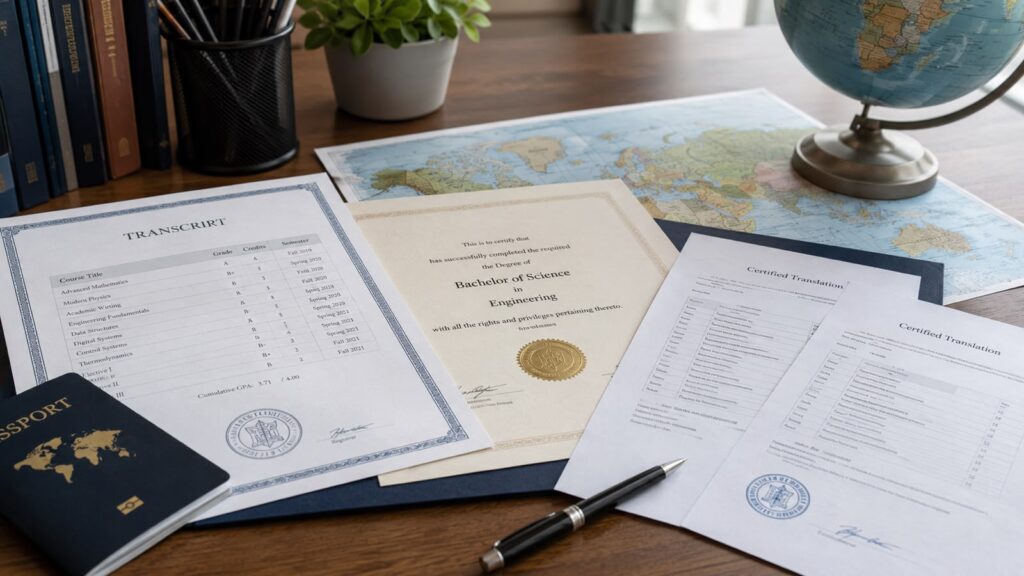
What “certified translation requirements” usually mean for academic records
For academic documents, certified translation requirements usually include three expectations.
First, completeness. The translation should include every section the institution uses to evaluate the record. That includes course lists, grades, credit hours, dates, and academic standing notes.
Second, consistency. Course titles, course codes, and program names should be translated consistently throughout the packet. If “ENG 101” is translated one way on one page and another way on a second page, it looks unreliable even if it is technically correct.
Third, certification. Many receiving offices want a translator certification statement that confirms the translation is accurate and complete. Some offices require this statement even if the translation is otherwise perfect.
Some institutions also want the translation to reflect stamps, seals, and signatures. If a stamp is visible but not readable, a translator will often indicate it in brackets. This helps the receiving office understand the record has an official stamp even if the text is not fully legible.
Certified translation vs sworn translation for academic records
This is the point that causes the most rework.
A U.S. certified translation usually means the translator provides a certification statement. Many institutions accept that.
A sworn translation usually refers to a translator with a legal status in a specific system, often in the destination country. Some countries require sworn translation for official filings, and a U.S. certification statement will not substitute.
If the destination checklist says sworn translation, do not guess. Ask one direct question.
Do you require a sworn translator registered in your country, or will a certified translation with a translator certification statement be accepted?
If they require sworn translation in-country, you may still translate in the U.S. for personal review, but your official submission translation needs to follow their sworn translator rule.
Translation timing for academic packets
Academic records are often updated, reissued, or reformatted. That is why translation timing matters.
In most cases, translate after the document version is final. If your packet also needs an apostille or authentication attachment, translate after that is complete so the translation matches the final packet you will submit.
This matters because some institutions want the translation to include the apostille page or the full attachment set. If you translate first and authenticate later, your translation may be incomplete.
If you need an apostille step for the final academic record packet, use apostille packet support.
What to translate on a transcript
Academic translations fail most often when the translator only translates the obvious parts and skips the evaluation-critical parts.
Most receiving offices expect the translation to include:
- Student name and identifiers exactly as shown
- Institution name, campus, and issuing office details
- Program name and degree level
- Dates of attendance and graduation date if shown
- Course list with course codes and course titles
- Credits, units, or hours exactly as stated
- Grades and grade symbols exactly as shown
- Transcript legend and grading scale notes
- Academic standing notes such as probation, honors, incomplete, withdrawn
- Registrar signature lines, stamps, seals, and certification language on the transcript
If the transcript includes a verification page or a legend page, include it. Skipping it is one of the most common reasons a translation is considered incomplete.
What to translate on a diploma or degree certificate
Diplomas are usually shorter, but they still include details that must be mirrored accurately.
Most receiving offices care about:
- Full name exactly as written
- Degree name and level
- Major or program name if shown
- Institution name
- Date of conferral
- Any official signatures and titles
- Any seals or stamp indicators
Diplomas can cause delays if the receiving institution expects a transcript instead. That is why it helps to confirm whether the diploma is required or optional.

When notarization shows up in academic translation workflows
Some academic packets include a supporting statement, such as:
- A registrar letter confirming graduation
- An affidavit explaining a name difference
- A statement verifying that the transcript is issued by the institution
- A consent statement for record release
If a supporting statement must be notarized, notarization should happen before final translation so the translated packet reflects the executed version.
If you need a notarization appointment in Los Angeles, explore our notary appointment options.
Do not notarize official records like certified transcripts as a default fix. Notarization is for documents being signed, not a replacement for official issuance.
Quick reference table
| Academic document | What institutions usually want translated | When to translate | Most common delay |
| Official transcript | Transcript plus legend, grading scale notes, stamps, signature lines | After you have the final official transcript and any required authentication attachments | Translating an unofficial transcript or skipping the legend page |
| Diploma or degree certificate | Diploma content, signatures, seal indicators | After you confirm the diploma is required and you have the final version | Translating a diploma first when the destination wants a transcript |
| Registrar verification letter | Entire letter plus any stamp and signature details | After the final signed letter is issued | Using an informal email instead of an official letter |
| Course descriptions or syllabi | Specific courses requested by the evaluator | After you confirm exactly which courses are required | Translating extra material that is not needed, then missing required courses |
| Mixed academic packet | All required academic documents in one consistent set | After the packet is finalized | Translating items in separate versions that do not match each other |
| Sworn translation required | Translation produced in the required sworn translator system | Follow the destination rule | Paying for a U.S. certified translation that is not accepted |
Step by step: the clean way to meet certified translation requirements for academics
Step 1: Confirm what the receiving office will accept
Ask what they want in plain terms.
- Do you want the official transcript, the diploma, or both?
- Do you need course descriptions or only the transcript?
- Do you require certified translation with a translator certification statement, or sworn translation?
These answers define your scope.
Step 2: Obtain the final official version
Academic documents are often reissued in different formats. Make sure you have the version you will actually submit.
If you only have an unofficial transcript, do not translate it yet if the receiving office requires an official transcript.
If the school offers a registrar letter that is accepted, obtain the official signed letter.
Final version first, translation second.
Step 3: Decide whether authentication or apostille is required
Some destinations require the academic document to be authenticated. Others do not.
If it is required, complete that step before final translation so the translation can match the final packet.
Step 4: Translate the complete record set
This is where certified translation requirements are either met or missed.
Ensure the translation includes legends, grading notes, and any visible stamp or certification language.
Ensure consistent translation of course names and program names.
Include a translator certification statement if required.
Step 5: Keep the packet stable after translation
Avoid replacing documents after translation unless you must.
If you replace a transcript with a new issue date or a different format, your translation may no longer match the final packet the receiving office will evaluate.
Conditional requirements
If the destination accepts English academic documents
Some institutions accept English transcripts. Others still want translation for their internal processing.
Do not assume. Confirm. If English is accepted, you may not need translation at all.
If the destination requires sworn translation
Confirm whether sworn means in-country sworn translator. If yes, plan around that system and avoid spending on a U.S. translation you cannot use officially.
If your school can only provide a digital official transcript
Some receiving offices accept digital official transcripts, but translation still must match what is submitted.
Confirm whether they require a printed certified version, a sealed transcript, or whether the digital official version is acceptable.
Then translate the version you will submit.
If your packet includes a name difference
Name differences are common on academic records. If your passport name differs from the transcript name, the receiving office may require an explanation document.
Confirm whether they want a supporting affidavit. If yes, translate that affidavit as part of the full packet.
If the packet includes an FBI record for licensing or immigration
Some professional pathways require a background check plus academic proof.
Treat the academic translation and the background check translation as two lanes. If you need the FBI lane, use FBI check service details.
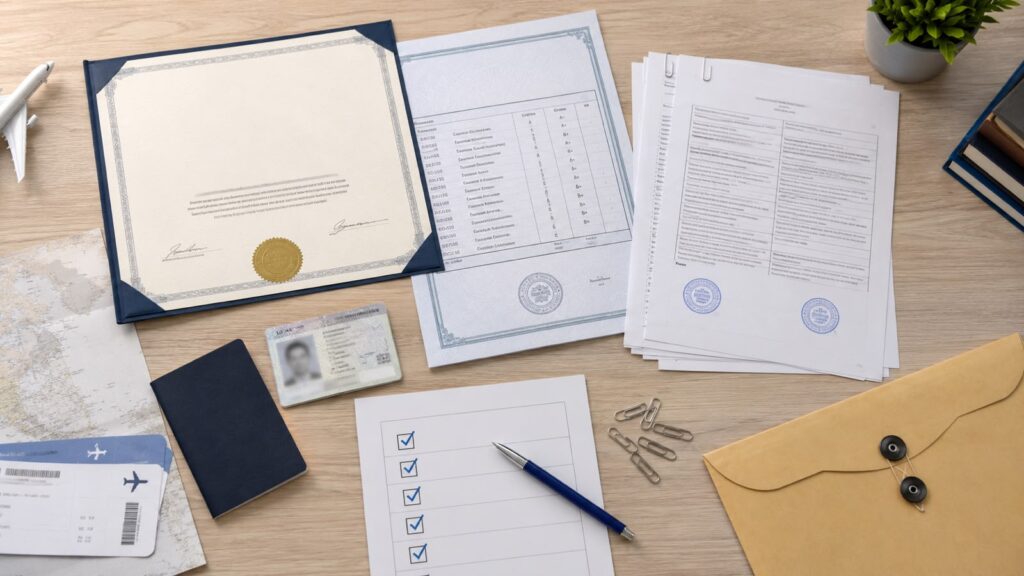
Common mistakes that cause academic translation delays
Translating an unofficial transcript when an official transcript is required
- Skipping the transcript legend, grading scale notes, or academic standing notes
- Using inconsistent translations for course titles or program names
- Translating before the final record version is issued
- Assuming notarization replaces official issuance
- Providing a certified translation when sworn translation is required in-country
- Translating only the transcript when the receiving office expects the apostille attachment to be included in the translation
- Not including a translator certification statement when the office requires it
FAQs
Do academic records always need translation for international use?
No. It depends on whether the receiving institution accepts English documents. Many require translation for non-English official processes.
What do certified translation requirements usually mean for transcripts?
It usually means a complete translation of the transcript including legends and grading notes, plus a translator certification statement confirming accuracy and completeness.
Should I translate my transcript before or after apostille?
In most cases, translate after any required apostille or authentication step so the translation matches the final packet you will submit.
Do I need to translate the grading scale and legend?
Often yes. Many institutions rely on the legend to interpret grades and credits. Skipping it can make the translation incomplete.
What if my school only provides an unofficial transcript?
If the receiving office requires an official transcript, request the official version first. Translating an unofficial version often leads to rework.
Does notarizing a translation make it a sworn translation?
No. Notarization usually only verifies the signer’s identity. Sworn translation typically refers to a translator authorized under a specific legal system.
What is the biggest reason academic translations get rejected?
Incomplete scope, especially missing legends and grading notes, and translating the wrong record version are the most common causes.