Brazil’s Status Under the Hague Apostille Convention
Brazil accepts apostilles under the Hague Apostille Convention. In practical terms, that means a U.S. apostille verifies the authenticity of the signature and seal on a U.S. public document so it can be used in Brazil without extra embassy authentication in many common cases.
This is where people get a false sense of simplicity. The apostille confirms the document is real. It does not change what Brazil is allowed to ask for. A Brazilian cartório (registry office) or government agency can still reject a document if it is not the right version, not properly issued, or missing required supporting steps like translation.
So the goal is not just “get an apostille.” The goal is “get the correct apostille for the exact document Brazil asked for.”
Which U.S. Documents Are Commonly Apostilled for Use in Brazil?
Most U.S. apostille requests for Brazil fall into three groups: vital records, academic documents, and
business or corporate documents.
Vital Records (Personal and Family Documents)
These are the documents people use for marriage in Brazil, residency applications, dual citizenship processes, or family-related matters handled
through Brazilian offices.
- Birth certificates
- Marriage certificates
- Divorce decrees and final judgments
- Death certificates (often for inheritance or family record updates)
- Court orders for name changes
The main rule with vital records is this: Brazil usually expects an official certified copy issued by the correct authority.
A photocopy of a birth certificate is not the same thing. A hospital keepsake certificate is not the same thing. A “downloaded record” is usually
not the same thing.
If your vital record was issued in California, that is typically a California apostille path. If it was issued in another state, it usually needs to
be apostilled by that state, not California.
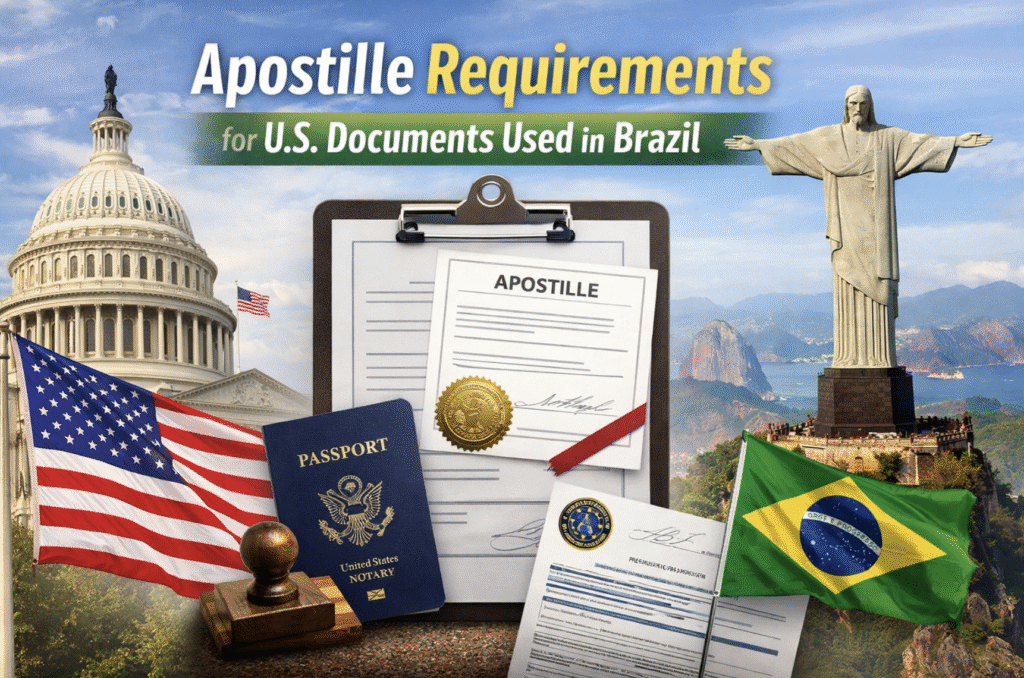
Understanding when U.S. documents need a California apostille vs a federal apostille for use in Brazil.
Academic Documents (School and Education Paperwork)
Education documents can be used for enrollment in a Brazilian university, proof of a degree for professional recognition, or supporting paperwork for
visas and residency.
- Diplomas or degree certificates
- Official transcripts
- Letters of enrollment or graduation verification
- Professional licenses or certifications (depending on the program)
Academic documents are where people lose time because the document in their hand is often not apostille-ready.
A diploma itself is commonly decorative. Many states will not apostille a plain diploma copy unless it is supported by a properly prepared school-issued
record, or a registrar statement that is notarized correctly and then apostilled in the correct state.
If the school is in California and the document is prepared and notarized properly in California, it can be handled as a California apostille.
If the school is outside California, it typically needs to follow that state’s rules.
Business and Corporate Documents
Business documents come up when someone is opening a Brazilian company, working with Brazilian partners, appointing a representative in Brazil, or signing
contracts where Brazil wants proof of authority.
- Articles of Incorporation or formation documents
- Certificates of Good Standing
- Board resolutions
- Powers of attorney for use in Brazil (often called “procuração” on the Brazilian side)
- Operating agreements or corporate bylaws (when requested)
- Certain federal tax or agency letters (when applicable)
Business files often include a mix of state and federal documents. That is why it is common for one Brazil packet to require both a state apostille and a federal apostille.
If you are creating a power of attorney or sworn statement that needs notarization before apostille, that notarization must be done correctly from the start. For Los Angeles-based execution, this is where mobile notary support can help before the apostille stage.
California Apostille vs Federal Apostille for Brazil
This is the decision point that causes the most delays, especially for people in Los Angeles who assume California handles everything.
When a California Apostille Applies
A California Secretary of State apostille generally applies when the document is one of the following:
- Issued by a California public office (common for California vital records)
- Signed by a California public official whose signature is on file for authentication
- Notarized by a California notary, where notarization is the correct preparation step for that document type
If you are holding a California birth certificate, a California marriage certificate, or a properly prepared California notarized document intended for Brazil,
this is typically a California apostille situation.
When a Federal Apostille Is Required
A federal apostille is usually required when the document is issued by a U.S. federal agency. Common examples for Brazil include:
- FBI Identity History Summary (FBI background check), when required for visas or residency
- Federal court documents
- Other federal agency documents that are signed and sealed by federal officials
Federal apostilles are handled through the U.S. Department of State, and the processing jurisdiction is Washington, DC. When your Brazil checklist includes
an FBI background check, the process often starts with fingerprinting. In Los Angeles, many people handle that part locally first through Live Scan
fingerprinting services, then proceed to the federal authentication step once the FBI result is issued in the correct format.
What If Your Document Was Issued in Another State (Not California)?
Living in Los Angeles does not change where a document must be apostilled.
- A Florida birth certificate usually needs a Florida apostille.
- A New York degree verification usually needs New York preparation and an apostille.
- A Nevada marriage certificate usually needs a Nevada apostille.
One of the most common delays is sending an out-of-state vital record to California and waiting, only to learn it cannot be apostilled in California at all.
Quick Reference Table: Which Apostille You Need for Brazil
| Document type | Common examples | Which apostille do you usually need? | Common mistake that causes delays | What Brazil often requires next |
|---|---|---|---|---|
| California vital records | CA birth, marriage, death certificate | California Secretary of State | Using an informational copy or photocopy | Portuguese translation, often sworn, then filed with the Brazilian agency or cartório |
| Out-of-state vital record | TX birth certificate, NV marriage certificate | Apostille from the issuing state | Submitting to California instead of the issuing state | Portuguese translation, then filing in Brazil |
| Academic documents tied to CA | Transcript, registrar letter, enrollment verification | A California apostille, if prepared correctly | Apostilling a diploma copy without proper school-issued support | Translation, then submission to the Brazilian school or authority |
| Corporate documents issued by a state | Certificate of Good Standing, Articles of Incorporation | Apostille from the issuing state | Using online printouts instead of certified documents | Translation, then submission to Brazilian partners or the registry process |
| Federal documents | FBI background check | Federal apostille through the U.S. Department of State | Trying to get a state apostille for a federal document | Translation, then submission for the Brazil process that required it |
Common Mistakes and Delays That Applicants Run Into
Mistake 1: Apostilling the Wrong Version of a Vital Record
Brazil commonly expects a certified record. People often try to apostille a photocopy because it is what they have on hand.
Fix: Order the correct certified copy first, then apostille the certified copy through the correct state.
Mistake 2: Trying to Apostille an Out-of-State Document in California
This is a classic Los Angeles problem. Someone lives in LA, has a document from another state, and assumes California can apostille it.
Fix: Match the apostille to the state that issued the document.
Mistake 3: Mixing Up State and Federal Apostille Authority
This shows up most with FBI background checks. A federal document usually cannot be apostilled by California.
Fix: Treat federal documents as a separate track that goes through the federal authority.
Mistake 4: Academic Documents That Are Not Prepared in an Apostille-Ready Way
Diplomas and unofficial transcripts are the biggest culprits. Brazil may want proof of education, but the state apostille office needs a document that is eligible
for authentication.
Fix: Use official transcripts or a properly prepared registrar statement that meets the issuing state’s apostille requirements.
Mistake 5: Not Planning for Brazil’s Translation Expectations
People finish the apostille and think the packet is complete. Then the Brazilian side requests a Portuguese translation, sometimes a sworn translation for official filing.
Fix: Build translation time into your timeline. Do not wait until the last day.
Mistake 6: Name Mismatches Across Documents
Brazilian agencies and cartórios may compare names, parents’ names, dates, and places across multiple records. If one record uses a middle name and another does not,
it can slow things down.
Fix: Review your entire set of documents before apostilling. If something needs correction, fix it first, not after the apostille.
A Practical Checklist Before You Submit Documents for Brazil
- Confirm what the Brazilian agency or cartório is requesting: original, certified copy, or notarized statement.
- Confirm the issuing authority: California, another state, or federal.
- Confirm you have an apostille-eligible version of the document, not a printout or photocopy.
- Separate state and federal tracks early so you do not send the wrong item to the wrong office.
- Plan for Portuguese translation, especially if sworn translation will be required in Brazil.
- Double-check names and details across documents so you do not have to redo apostilles later.
FAQ: Apostille Requirements for Brazil
Does Brazil accept apostilles from the United States?
Yes. Brazil is part of the Hague Apostille system, so a properly issued U.S. apostille is generally the accepted authentication method for U.S. public documents used in Brazil. The document still needs to be the correct official version for the apostille to be valid.
Do I need a California apostille or a federal apostille for Brazil?
It depends on who issued the document. California-issued or California-notarized documents typically use a California Secretary of State apostille. Documents issued by U.S. federal agencies, like an FBI background check, typically require a federal apostille through the U.S. Department of State.
Can I apostille an out-of-state birth certificate in California if I live in Los Angeles?
Usually no. A birth certificate is typically apostilled by the state that issued it. Living in California does not change the issuing authority, so California cannot usually apostille another state’s vital record.
What U.S. documents are most commonly apostilled for Brazil?
The most common categories are vital records (birth and marriage certificates), academic documents (transcripts and degree verification paperwork), and business documents (Certificates of Good Standing, formation documents, and powers of attorney). The exact list depends on whether you are dealing with citizenship, marriage, residency, school, or a business process in Brazil.
Do my apostilled documents need to be translated for Brazil?
Often, yes. Many Brazilian agencies require Portuguese translation, and for official filing inside Brazil, they may require a sworn translation called tradução juramentada.
An apostille confirms authenticity but does not replace translation requirements.
Why do apostille requests for Brazil get delayed?
The most common reasons are using unofficial copies, sending documents to the wrong state, confusing the state and federal apostille authority, and not preparing academic or corporate
documents in an apostille-eligible format. Name mismatches across documents can also create delays on the Brazil side.
If I have multiple documents, can some need a California apostille and others need a federal apostille?
Yes, that happens a lot. For example, someone might need a California apostille for a California birth certificate and a federal apostille for an FBI background check. Planning these as
separate tracks early helps prevent delays.