
How do I complete document authentication for United Arab Emirates (UAE) in Los Angeles?
To complete document authentication for United Arab Emirates (UAE) from Los Angeles, start by matching your document to the correct lane. State-issued documents (like birth certificates, marriage certificates, court orders, and state business filings) must begin in the issuing state. Notarized documents (like a power of attorney or affidavit) must begin in the state where the notarization happened, which is usually California if you sign and notarize in Los Angeles.
Because the UAE typically requires a legalization chain rather than a simple apostille-only step, the packet usually follows a sequence like this: state authentication first (for state-issued or California-notarized documents), then federal authentication, then UAE legalization through the appropriate UAE consular or embassy channel. For many UAE uses, the process may also include a final UAE-side attestation step after the embassy stage, depending on what the receiving office requests.
If your document is federal (for example, an FBI background check), it follows a federal route first and then continues into the UAE legalization step. Most delays happen when the wrong document version is used (photocopies instead of certified copies), notarization is incomplete, or steps are done out of order.
Why apostilles are not the right framework for UAE legalization
This is the first point that prevents confusion. UAE document preparation is commonly handled through legalization and attestation steps rather than a simple apostille shortcut.
That matters because it changes what “done” looks like. For authentication for United Arab Emirates (UAE), the receiving institution typically wants a chain that proves the document was verified through state and federal channels and then legalized by the UAE embassy or consulate.
If someone says “just get an apostille,” the practical translation is usually: “complete the UAE legalization chain.” UAE processes are often employment- and residency-driven, and institutions tend to expect the formal chain, not a single stamp.
To understand how legalization differs from a traditional apostille process, review our Apostille Services page.
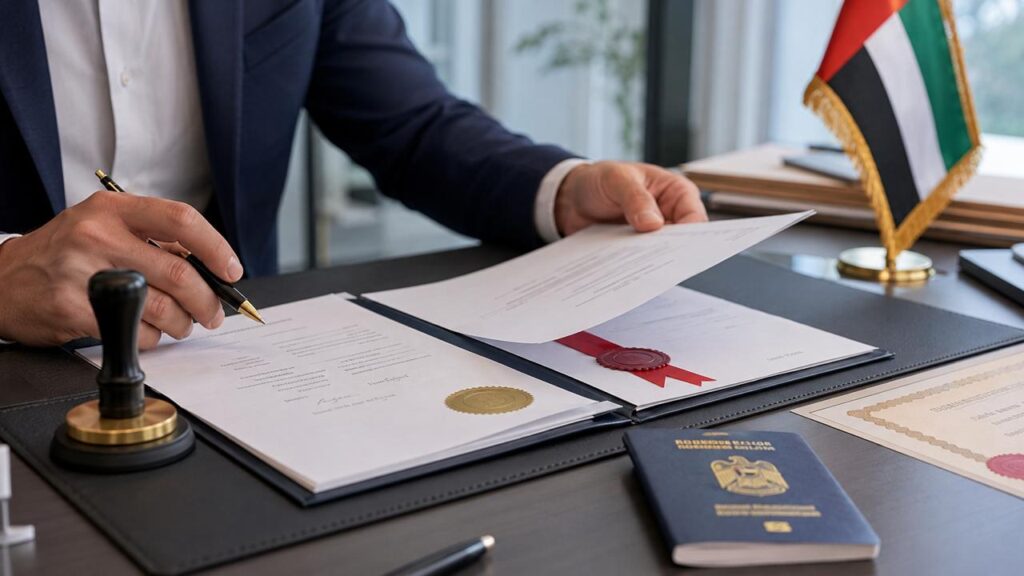
What U.S. documents are commonly legalized for UAE
Most United Arab Emirates (UAE) document legalization requests fall into three buckets: vital records, academic documents, and business or corporate documents. The bucket matters because it determines what version you need and whether notarization is part of the first step.
Vital records (personal and family documents)
Vital records are common for family sponsorship, residency processes, marriage and civil status matters, and official identity proof.
Common examples include:
- Birth certificates
- Marriage certificates
- Divorce decrees or final judgments
- Death certificates
- Court orders for name changes
The biggest cause of delay is starting with the wrong version. UAE receiving offices typically want certified records, not photocopies, screenshots, or informational copies. Legalization cannot fix an unofficial copy. It only authenticates what is already official.
Academic documents
Academic documents are commonly required for employment, work permits, regulated professions, and some residency pathways.
Common examples include:
- Diplomas and degree certificates
- Official transcripts
- Letters of enrollment or graduation verification
- Professional certificates
Academic delays often happen because people start with a casual diploma copy. Many legalization workflows move more smoothly when you start with an official transcript or a registrar-issued verification letter prepared in a format that can be authenticated cleanly.
Business and corporate documents
Business documents come up for banking, contracts, corporate registration, and appointing representatives.
Common examples include:
- Certificates of Good Standing
- Articles of Incorporation or formation documents
- Board resolutions
- Powers of attorney for UAE use
- Corporate authorization letters
- Compliance affidavits
Business packs usually include a mix of certified public records and signed documents. That matters because they start differently. Certified records start with the official certificate. Signed documents usually start with notarization.
If you need a power of attorney or authorization letter notarized in Los Angeles before legalization, schedule through Notary Public so the execution is clean before the chain begins.
The UAE legalization chain at a glance
For authentication for United Arab Emirates (UAE), the chain is usually built in order. The common version looks like this:
- Start with the correct official document format
- Notarize only if the document is one that should be notarized
- State authentication (based on issuing state or notarization state)
- Federal authentication through the U.S. Department of State
- UAE embassy legalization
- If required by the receiving institution, UAE MOFA attestation after embassy legalization
Not every document starts with notarization. A certified birth certificate usually does not. A power of attorney usually does. The main rule is: once you start the chain, do not reorder the steps.
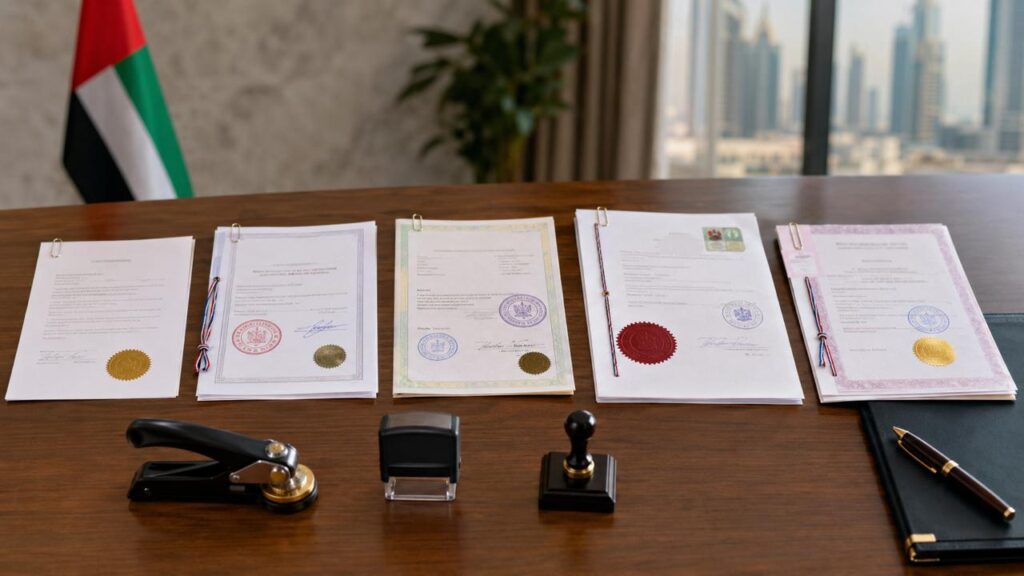
Quick reference table: common documents and the chain
| Document type | Best starting format | U.S. steps usually required | Most common delay |
| State-issued birth or marriage certificate | Certified copy issued by the proper authority | State authentication → federal authentication → UAE embassy legalization | Using an informational copy or printout |
| Divorce judgment or court order | Certified complete court copy (all pages) | State authentication (when required) → federal authentication → embassy legalization | Missing pages or uncertified copy |
| Diploma or education proof | Official transcript or registrar verification letter | Notarization (if required) → state authentication → federal authentication → embassy legalization | Trying to legalize a casual diploma copy |
| Certificate of Good Standing | Official certificate issued by the state | State authentication → federal authentication → embassy legalization | Using a website screenshot instead of the official certificate |
| Power of attorney for UAE | Original signed document, properly notarized | Notarization → state authentication → federal authentication → embassy legalization | Notarial certificate errors or signer name mismatch |
| Federal record (if required) | Official federal-issued document | Federal authentication → embassy legalization | Trying to route a federal record through a state step |
Step by step: completing authentication for United Arab Emirates (UAE) from Los Angeles
Step 1: Confirm the UAE-side requirement first
Start with the receiving institution in the UAE and confirm three things:
- What exact document they want (certified record, original, or notarized statement)
- Whether they require a recently issued version
- Whether translation is required and what format they accept
This prevents the most expensive mistake: legalizing the wrong version and then being told to reorder it and restart the chain.
Step 2: Identify what you actually have in hand
For authentication for United Arab Emirates (UAE), your starting point changes based on document type.
If it is a certified public record (like a certified birth certificate), you typically start with the certified copy and move into state authentication.
If it is a document you created (like a power of attorney, affidavit, or authorization letter), notarization is often the first step.
If it is a business packet, separate certified certificates from signed documents and treat them differently.
Step 3: Notarize only what should be notarized
A major delay is notarizing things that should have been ordered as certified copies.
Do not notarize a photocopy of a certified birth certificate and assume it becomes acceptable. Most UAE use cases expect the certified record itself.
Do notarize documents that are meant to be signed authorizations, like powers of attorney and sworn statements.
Step 4: Complete state authentication based on issuer
State authentication is tied to the state that issued the record or the state where the notarization occurred.
California-issued or California-notarized documents follow California’s state path.
Out-of-state documents generally must follow that state’s path.
This is where LA applicants often lose time. They try to process an out-of-state record through California. The issuer controls the state step, not your current address.
Step 5: Complete federal authentication through the U.S. Department of State
For authentication for United Arab Emirates (UAE), federal authentication is typically required after the state step for state-issued or state-notarized documents.
This is a separate authority layer. It is not interchangeable with a state stamp.
If your packet includes an FBI background check, you can start the request process here: FBI record request help.
Step 6: UAE embassy legalization finishes the U.S. side of the chain
After completing the required U.S. authentication steps, follow the current UAE Embassy document-attestation guidance for the destination-country stage. Effective August 21, 2025, the UAE Embassy states that attestation applications for personal and educational documents are handled through VFS Global, and the documents must first be authenticated by the U.S. Department of State.
Requirements can differ for personal, educational, and corporate documents, so verify the current submission channel, supporting documents, and fees before sending your packet.
Step 7: Ask whether UAE MOFA attestation is required
Many UAE processes include a final step after embassy legalization, often called MOFA attestation.
Not every receiving institution requires it, but it is common enough that you should confirm it early. If MOFA attestation is required, build it into your timeline.
If translation is part of the UAE process, you can reference translation support for international documents with to help keep your legalization packet consistent.
Conditional requirements: how the process changes
If your documents are California-based only
California-based documents can move faster from Los Angeles because your early steps are local. The main risks are using the wrong vital record version or having a notarization mistake on signed documents.
If your packet includes out-of-state documents
Out-of-state documents add timeline. The issuing state controls the state authentication step. Order certified copies early and plan buffer time.
If your packet includes federal records
Federal records do not follow the same state-authentication start as state documents. Treat federal items as their own lane and plan for federal authentication before embassy legalization.
If your packet includes a power of attorney
Powers of attorney are high-stakes documents for the UAE. Notarial execution quality matters. A single mistake can force a full redo.
If translation is required
Translation timing can vary. Some receiving offices want translation after legalization, some specify a different order. Confirm first, then follow the instructed sequence.
Common mistakes that delay UAE legalization
Starting with an unofficial document is the top problem. Photocopies and downloads are frequently rejected.
Notarization errors are the next big issue. Incomplete certificates, signer name mismatches, and missing pages break the chain early.
Skipping steps or reordering the chain causes rejection. The process depends on sequence.
Treating all documents the same causes confusion. Certified records and notarized documents start differently.
Waiting too late removes your buffer. Out-of-state ordering, federal authentication, and embassy legalization take time.
A quick check now can save you a full redo later. Confirm you have the correct official document version, confirm any notarization is completed correctly on the final document, and confirm whether your packet must go through both state and federal authentication before UAE legalization. Keeping the lane and order clean from the start is the fastest way to avoid delays, rejections, or resubmissions.

FAQs
Is the UAE an apostille destination for U.S. documents?
The UAE typically requires a legalization chain rather than an apostille-only process. That means documents generally must be authenticated through the correct U.S. state and federal steps and then legalized through the appropriate UAE consular or embassy channel.
What is the first step for document authentication for United Arab Emirates (UAE) in Los Angeles?
Start by identifying what kind of document you have and where it was issued or notarized. California-issued or California-notarized documents usually start in the California lane. Out-of-state documents start in their issuing state. Federal documents start in the federal lane.
Do California notarized documents need California authentication first?
Yes. If your document is notarized in California, it typically must go through the California authentication stage first before continuing through federal authentication and then UAE legalization.
What if my document is an FBI background check?
An FBI background check is a federal document, so it follows a federal route first and then continues into the UAE legalization step. Sending a federal document into a state lane is a common reason for delays.
What causes the biggest delays in the UAE legalization chain?
The most common delays come from using the wrong document version, incomplete notarization, starting in the wrong lane (state vs federal), missing a required authentication stage, or doing steps out of order.
Should I translate before or after legalization?
In many cases, it is cleaner to complete the authentication and legalization steps first and then handle translation based on what the UAE receiving office requests. Confirm the receiving requirement early so you do not redo work.