
One letter, and the whole file came back
A document went to the California Secretary of State for an apostille. It was returned unprocessed. Nothing was wrong with the document, and nothing was obviously wrong with the notarisation.
The document had been signed by JOHN DOE. The notarial certificate attached to it named the signer as JOHN DOW.
One letter. The Secretary of State reads those two names and compares them, and a great many people are surprised to learn it. The assumption is that the apostille step is a formality — a stamp applied to whatever arrives. It is not. The office is authenticating a specific notary’s certificate concerning a specific signer, and if the paperwork disagrees with itself about who that signer was, there is nothing coherent to authenticate.
The rule underneath it states in one line: the notarial certificate must be issued for the person who actually signed, and the name must match exactly. Nearly everything that goes wrong with an apostille for business documents is a version of that same principle.
What an apostille actually certifies — and what it does not
An apostille certifies one narrow thing: that the signature, seal and official capacity on your document are genuine. It is a statement about who signed, not about what the document says.
This matters more than it sounds. A board resolution with an apostille attached has not been reviewed, approved or validated by anyone. The apostille says only that the notary who witnessed the signature was a real, commissioned notary in good standing. The party abroad still reads the resolution on its merits.
Which is why the question that decides everything is not “is my document important enough” but
“whose signature is the apostille going to certify?” Answer that, and the route follows.
The two routes
Business documents split into two categories that travel completely different paths. Confusing them is one of the most common reasons a file has to be started over.
Route 1: documents the state issued
A Certificate of Good Standing. A certified copy of your Articles of Incorporation. A certified copy of a Statement of Information or any other filing on record with the Secretary of State.
These already carry the signature of a state official. That signature is the one the apostille certifies, so the document goes straight to the Secretary of State for its apostille.
Do not have these notarised first. There is no signer to identify and no signature to witness, so a notary has no role. Adding a notarial certificate to a state-issued record does not strengthen the package — it introduces exactly the kind of inconsistency described above, with a certificate naming somebody who did not sign anything.
Route 2: documents your company created
A board resolution. A power of attorney. A commercial contract, a distributor agreement, an affidavit, a letter of authorisation.
These carry no official signature at all — only your own. There is nothing for the state to certify until a notary has identified the signer, witnessed the signature and attached their own certificate. These must be notarised first, and only then go to the Secretary of State.
This is where the name and the date have to be right, and where they most often are not. Both are covered below.
What a notary can certify — and what people believe a notary can certify
This is the single biggest misunderstanding we deal with, and it sends people down the wrong road before they have started.
There is a widespread belief that a notary holds some general power to verify documents — to look at a piece of paper and attest that it is genuine, accurate, or a true copy of something else. In California, that power does not exist.
A California notary can certify a copy of exactly two things:
- A power of attorney. And even then, the original and the copy both have to be physically present so they can be compared, page by page.
- The notary’s own journal. Which is an internal record — it is not something a client would ever need.
That is the complete list. Not corporate records. Not property records. Not academic transcripts. Not vital records. If a notary in California offers to certify a copy of any of those, something has gone wrong.
What can be done instead
Here is the distinction that actually solves the problem. A notary cannot certify that a document is true and correct — how would they know? They did not create it, do not hold the underlying record, and have no way to verify its contents.
But the custodian of the record does know. So the workable route is this: the custodian signs a statement attesting that the copy is a true and correct copy of the record they hold, and the notary notarises the custodian’s signature.
A registrar can sign such a statement about a transcript. A records officer can sign one about a property record or an electronic record. The notarial act attaches to their signature, made in their official capacity — which is a thing a notary is genuinely able to witness, and a thing the Secretary of State can then authenticate.
For company paperwork, the same logic points somewhere slightly different: what you usually need is a certified copy issued by the Secretary of State, not a notarised photocopy. If somebody abroad has asked you for a “notarised copy” of your Articles of Incorporation, the request as worded cannot be fulfilled in California. Order the certified copy from the state and apostille that.
Which of your documents need one
There is no universal list, because the requirement comes from the party receiving the document, not from any U.S. authority. In practice, these are what businesses send:
- Corporate records — Articles of Incorporation, Certificates of Good Standing, bylaws, board resolutions, Statements of Information
- Authority documents — powers of attorney, letters of authorisation, signature authority certificates
- Commercial agreements — contracts, distribution and agency agreements, joint venture documents, licensing agreements
- Financial records — bank letters, audited accounts, tax filings
- Intellectual property — patent and trademark assignments, licensing documents
- Trade documents — certificates of origin, product certifications, free-sale certificates
- Personnel documents — employment verification letters and professional licences
The route this page is not about
Everything above concerns documents authenticated by the California Secretary of State. That is where notarisation leads, and it is where the overwhelming majority of business documents go.
There is a separate federal route, and the thing to understand about it is that
no notary can put a document onto it. A federal apostille authenticates the signature of an officer of a federal agency. The document has to have been issued and signed by that agency in the first place.
Where this comes up in business is narrow but real. A pharmaceutical company opening in another market may have to show its FDA licences, signed by an officer of the FDA. An exporter may need an EPA record. Those go to the U.S. Department of State, and a notary has no part in it — there is no signature of yours to witness. The most familiar version for most companies is an FBI background check for someone being posted overseas.
The practical consequence: if somebody has told you a document needs to be “notarised and apostilled” and the document was issued by a federal agency, one of those two words is wrong. Taking it to a notary will not help and may create the kind of inconsistency described below.
If the destination is not a Hague member
The apostille is the whole of it only where the destination country is party to the Hague Apostille Convention. Where it is not, the California step is the same — the document is still notarised where notarisation applies, and still authenticated by the Secretary of State — but more is stacked on top afterwards, ending at the destination country’s consulate.
We deliberately do not publish a list of member countries; membership changes and a list that is right today quietly becomes wrong. Check the current requirement for your specific destination with the party who will actually receive the document, since receiving institutions sometimes ask for more than their country’s baseline.
Where these go wrong
Four failure modes account for most of what comes back.
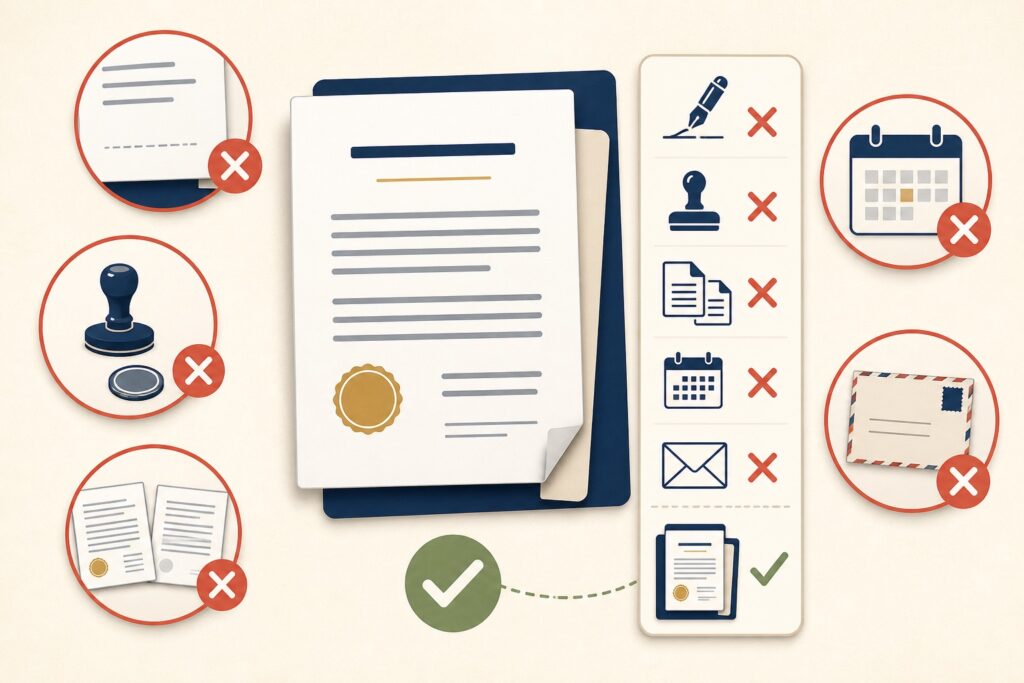
1. The name does not match exactly
JOHN DOE signs; the certificate says JOHN DOW. Or the identification reads “Robert Chen” and the signature block reads “Bob Chen, Managing Member”. A close match is not a match. The certificate has to name the signer as the signer actually appears, and any variation has to be handled in the wording rather than glossed over.
2. The notary is shown as having executed the document
This one arrives more often than it should. The notary’s signature ends up on the document itself, as though the notary were the party executing it, while a different person is named as the signer. It makes no sense on its face — the notary’s role is to witness and certify somebody else’s signature, not to sign the instrument. A file built this way cannot be repaired at the apostille stage. It has to be executed again, properly.
3. The dates do not line up
The notarial certificate is dated 20 August; the document says it was signed on 25 August. The signature is dated after the notarial act that certified it. That is not a clerical irregularity, it is an impossibility, and it is visible to anyone who reads both dates.
4. Somebody assumed a notary could certify a copy
The file is built around a notarial act that does not exist in California, and has to be rebuilt from the start — usually meaning a certified copy has to be ordered from the state, from scratch, against a deadline that is already running.
The date rule that catches people out
Because the third one has a wrinkle worth stating plainly: the date on a notarial certificate is the date the notarial act was performed — not the date on the document. Whether those two dates may differ depends entirely on which notarial act it is.
- An acknowledgment does not require the signer to sign in front of the notary. They may have signed days earlier; what they do before the notary is acknowledge that the signature is theirs. So a document dated earlier than the acknowledgment is perfectly normal.
- A jurat is different. The signer must sign in the notary’s presence, at that moment, and swear to it. There is no earlier signature to refer back to, so the dates have to match exactly.
A document dated after its notarial certificate is wrong in either case. But a document dated
before its certificate is fine on an acknowledgment and fatal on a jurat — and since the requesting party abroad is often the one who specified which of the two they wanted, this is worth checking before the signing rather than after the rejection.
What all four have in common is that none of them is a problem with the substance of the deal. They are questions about who signed what, and when. All of them are far cheaper to resolve before the file is sent than after it comes back.
Files with several documents, or several destinations
Most guidance treats this as one document going to one country. Real transactions rarely look like that.
A single deal might need a Certificate of Good Standing and certified Articles going one way, a board resolution and a power of attorney going another, and the whole set duplicated for a second jurisdiction. Each document may sit at a different point in the chain at any moment.
Two things make it manageable. Separate by route before you start — state-issued in one pile, company-created in the other — because the two move at different speeds and the state-issued pile can usually begin immediately. And order duplicates up front: if two jurisdictions each need a certified Certificate of Good Standing, that is two certified copies ordered at once. An apostille attaches to a specific original. It does not travel to a photocopy of itself.
If the document has to be translated
Most of these contracts are going somewhere that does not read English, and translation is where a well-prepared file can still come apart — because the rules about who may translate are set by the destination, not by you or by us. Our document translation and apostille page covers the general ground; what follows is what bites hardest on business documents.
Start with the same principle that governs copies. A notary cannot certify that a translation is accurate. We do not vouch for a translation any more than we vouch for the contents of a document — we have no way to know. What can be done is the equivalent of the custodian route above: the translator signs a statement that the translation is true and complete, and a notary notarises the translator’s signature. The notarial act attaches to the translator standing behind their own work, which is something that can properly be witnessed.
Note where that tends to happen. These translations are usually into the foreign language rather than out of it, so the translator is often located in the destination country — which means the signature is frequently notarised there, under that country’s rules, rather than here.
A sworn translation is a different thing again
A sworn translation is not a better-certified version of the above. It is a separate institution, and only some governments operate one at all.
Where a country does, it licenses particular translators, and the authority comes from that licence rather than from anything attached afterwards. The sworn translator signs and swears to the translation themselves. Spain is the example we deal with most, through its traductor jurado — a translator authorised by the Spanish government, whose oath Spain accepts precisely because of who is giving it. Our guide to Spanish sworn translations sets out how that works.
The consequence for anyone preparing documents here is blunt: no notarial act produces a sworn translation. A translation done and notarised in Los Angeles does not become one by being notarised, because the thing being relied on is the licence, not the signature. Where a sworn translation is what was asked for, nothing else substitutes.
Equally, do not assume you need one. Many countries operate no such system and will accept an ordinary certified translation. It is a narrow requirement attached to particular documents in particular countries, not a general standard — so ask the receiving body what it actually requires before commissioning anything. Our document translation and apostille page goes further into the differences between certified, notarised and sworn translations.
Sequence matters too. The usual order is apostille first, then translate the final version — because many receiving offices want the translation to reflect exactly what was submitted, stamps and apostille included. Translating first risks paying twice if the underlying document is reissued. There are exceptions, and our page on translation before or after an apostille sets out when they apply.
Settle three questions before anyone starts translating: who the destination requires to do it, whether the translation itself needs its own certification, and whether it should happen before or after the apostille. Getting those in the wrong order is one of the more expensive mistakes available, because the work usually has to be bought again.
Working to a closing or a filing deadline
We do not publish processing times — they move, and a number in a blog post is a poor thing to plan a closing around. But sequencing is stable, and sequencing is where the recoverable time sits.
Start with whatever you do not control. Certified copies from the Secretary of State, federal records, and anything requested from a third party all have a queue in front of them. Documents your own company creates can be drafted and signed on your own schedule, so they are the wrong thing to start with even though they feel like the easiest.
Then check currency. Many receiving parties will not accept a Certificate of Good Standing issued more than a short window before submission. Ordering one early and letting it go stale before closing is common and entirely avoidable.
Getting it looked at before you send it
The cheapest point to catch any of this is before the documents leave your desk. Something returned by an authenticating authority has not only lost the handling time — it has usually lost its place in whatever schedule it was attached to.
If you have documents heading abroad and you are not certain which route each one belongs on, that is a short conversation rather than a quote. Our
apostille services page covers the process generally, and we handle the notarisation side as well, including travelling to offices across Los Angeles when a signature has to happen somewhere other than our desk.
Frequently asked questions
Does an apostille mean my contract is legally valid abroad?
No. An apostille authenticates the signature and seal on the document, not its contents or its enforceability. Whether a contract is valid in the destination country is a question for the law of that country, and for your counsel there.
Can a notary certify that a copy of my document is genuine?
In California, only for a power of attorney — and the original and the copy must both be present so they can be compared. A notary cannot certify a copy of a corporate record, a property record, a transcript or a vital record. What can be done instead is to have the custodian of the record sign a statement that the copy is true and correct, and have the notary notarise the custodian’s signature.
The other side asked for a “notarised and apostilled” Certificate of Good Standing. What do I send?
Almost always they mean a certified copy with an apostille, and “notarised” has crept in as a general term for “officially certified”. Sending it to a notary first adds a step that cannot be performed. If the request is ambiguous, ask the receiving party what they need to see.
Our document came from another state with its own notary wording printed on it. Can a California notary use that form?
For an acknowledgment, often yes. California expressly permits a notary to complete an acknowledgment form required by another state or jurisdiction, on a document to be filed there. There is one limit that bites hard on business documents: the out-of-state form must not require the notary to determine or certify that the signer holds a particular
representative capacity. A great many out-of-state corporate forms do exactly that — “…who acknowledged himself to be the President of…” — and a California notary cannot complete those.
For a jurat, no. There is no equivalent provision. California prescribes its own jurat wording and requires the signer to sign in the notary’s presence and take an oath, so a California notary attaches the California form.
Note that this concerns documents travelling to another U.S. state. A document going abroad for an apostille follows the California route regardless of where your company is registered.
My document is dated earlier than the notarial certificate. Is that a problem?
It depends on which notarial act was performed. On an acknowledgment, no — the signer is permitted to have signed beforehand, and simply acknowledges the signature as theirs when they appear. On a jurat, yes — the signer must sign in the notary’s presence, so the dates must match exactly. A document dated after its notarial certificate is a problem either way.
Why was my document rejected when the notarisation looked fine?
The most common cause is a mismatch between the name on the notarial certificate and the name of the person who signed. The Secretary of State compares them. The certificate has to be issued for the actual signer, with the name correct.
Can business documents be apostilled electronically?
Some U.S. states support electronic notarisation and electronic apostilles, but many receiving authorities abroad still want an original paper document with a wet signature and a physically attached apostille. Confirm what the destination accepts before choosing an electronic route.
Our company is registered in Delaware but operates from California. Where do we file?
The apostille is issued by the state that issued the document. A Delaware Certificate of Good Standing is apostilled by Delaware regardless of where you operate. A document notarised by a California notary is apostilled by California. A single file can easily involve both.