
How do I complete document authentication for Kuwait step by step?
To complete document authentication for Kuwait from Los Angeles, start by matching your document to the correct lane. State-issued documents (like birth certificates, marriage certificates, court orders, and state business filings) must begin in the issuing state. Notarized documents (like a power of attorney or affidavit) must begin in the state where the notarization happened, which is usually California if you sign and notarize in Los Angeles.
Because Kuwait requires a legalization chain rather than an apostille-only process, the packet typically follows this order: state authentication first (for state-issued or California-notarized documents), then federal authentication, then Kuwait legalization through the appropriate Kuwait consular or embassy channel. If your document is federal (for example, an FBI background check), it follows a federal route first and then continues into the Kuwait legalization step.
Most delays happen when the wrong document version is used (photocopies instead of certified copies), notarization is incomplete, or steps are done out of order. Keeping the lane and order clean from the start is the fastest way to avoid rejections or resubmissions.
Because Kuwait generally requires legalization rather than a simple apostille, it helps to understand how international document authentication works before starting the process.
Why Kuwait uses legalization instead of apostille
A lot of people search “apostille for Kuwait” and assume the process will be the same as Spain, Brazil, or Portugal.
Kuwait is different.
Kuwait is not treated as a Hague Apostille partner for U.S. documents, so an apostille is typically not sufficient for official use in Kuwait. Instead, documents must go through authentication and then embassy legalization.
That single difference changes everything.
- With apostille countries, you usually stop after the correct state or federal apostille.
- With Kuwait, you normally keep going until the Kuwait Embassy legalizes the document.
If you remember only one rule, remember this: document authentication for Kuwait is an ordered chain, and skipping a link breaks the chain.
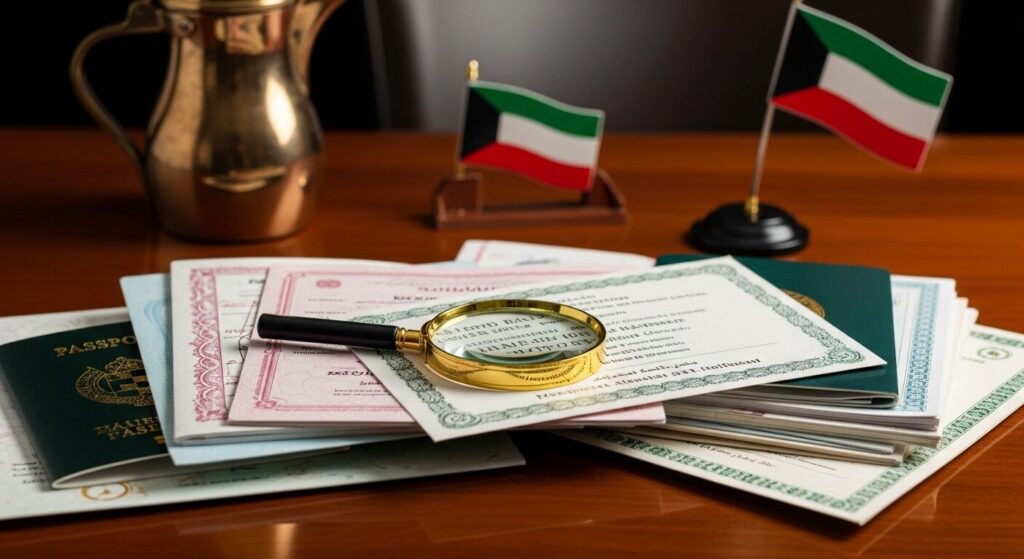
What U.S. documents commonly need document authentication for Kuwait
Document authentication for Kuwait usually involves one of three buckets: personal and vital records, academic records, and business or commercial documents.
The chain is similar, but the starting point can differ based on the document type and where it was issued.
Personal and vital records
These are common for residency, family sponsorship, marriage steps, school enrollment, and civil status matters.
Typical examples include:
- Birth certificates
- Marriage certificates
- Death certificates
- Divorce decrees or court orders
- Name change court orders
- Police clearance letters, depending on the requesting party
- Affidavits, if requested by an employer or Kuwaiti authority
The biggest issue in this bucket is document version. Kuwait-facing processes usually expect official originals or properly certified copies, not photocopies.
Academic records
These show up for work visas, professional licensing, and some employment onboarding.
Typical examples include:
- Diplomas and degree certificates
- Official transcripts
- Letters from a registrar confirming graduation
- Professional training certificates, depending on the role
Academic documents often trigger extra verification steps because schools issue documents in different formats. What matters is what the Kuwaiti receiving party accepts.
Business and commercial documents
These show up for company registration, contract work, authorizations, and corporate transactions.
Typical examples include:
- Certificates of good standing
- Articles of incorporation or formation
- Board resolutions
- Powers of attorney for business representation
- Commercial invoices or shipping documents (in some contexts)
- Company letters on letterhead that require notarization
This bucket is where the chain can become strict and paperwork-heavy. If your receiving party in Kuwait is a government ministry or a regulated entity, they often want the chain completed exactly.
The core concept: every document has a “lane”
Before you start document authentication for Kuwait, identify which lane your document belongs to.
There are three common lanes.
- State-issued documents
- State-notarized documents
- Federal documents
If you choose the wrong lane, your chain either gets rejected immediately or you waste time repeating steps.
Step-by-step document authentication for Kuwait
This is the practical chain most U.S. applicants follow. The exact details can vary by document type, but the order below reflects the standard logic: state level first (when applicable), then U.S. Department of State authentication, then Kuwait Embassy legalization.
Step 1: Start with the correct document version
Before you authenticate anything, confirm the document is acceptable in its base form.
- For vital records, that often means a certified copy, not a photocopy.
- For court orders, that often means a certified court copy with all pages.
- For academic records, that may mean an official transcript or registrar letter, not a casual copy.
- For business documents, it may mean a certified filing or a final executed document.
This is where many delays begin. People authenticate the wrong version, then Kuwait rejects it for being unofficial.
Document authentication for Kuwait does not fix an unofficial document. It only validates signatures and seals.
Step 2: If the document must be notarized, notarize it correctly first
Many Kuwait-bound documents are private documents. That means they are not issued by a government office, so the chain usually starts with notarization.
Common examples:
- Powers of attorney
- Affidavits and sworn statements
- Company authorization letters
- Certain school letters or identity declarations
If you need notarization, do it before the rest of the chain, and do it correctly. One missing notarial element can break the next step.
If you need a notary appointment, visit our notary public page: notary appointment.
Step 3: County clerk authentication (only when required for your state workflow)
Some state workflows require a county clerk step before the state will authenticate a notary.
This is not universal, and it varies by state and by how the notary was commissioned and recorded.
This is a classic delay point in document authentication for Kuwait.
- People skip the county step when their document needs it.
- Or they do the county step when it is not required and lose time.
The correct approach is simple: follow the state’s authentication rules for notarized documents. If your document is a certified vital record, you may not need a county step.

Step 4: State authentication (Secretary of State) for state documents
State authentication is the step where the state verifies the signature or seal of a state official or a notary.
This usually applies when your document is:
- A state-issued record (like a state vital record)
- A notarized document notarized in that state
- A state-certified corporate record
This step is a core part of document authentication for Kuwait because it prepares the document for the federal authentication step.
If your document was issued in California, you typically use California’s process. If your document was issued in another state, you typically use that state’s process.
Step 5: U.S. Department of State authentication
After the state authentication step (for state documents), U.S. documents typically move to the U.S. Department of State for federal authentication before embassy legalization.
This is often the step people do not plan for, especially when they are trying to meet a travel or visa timeline.
If you are doing document authentication for Kuwait, you should assume the federal authentication step is part of the chain for most state documents used internationally through embassy legalization.
Step 6: Embassy of Kuwait legalization (final step)
The final link is Kuwait Embassy legalization in Washington, D.C. This is the step Kuwaiti authorities typically look for as proof the chain was completed for Kuwait.
This is the finish line for document authentication for Kuwait.
- If a document stops at the state level, Kuwait usually will not accept it.
- If a document stops at U.S. Department of State authentication, Kuwait usually will not accept it.
The embassy legalization step is what makes the chain Kuwait-ready.
Quick Reference Table
| Document type | Starts in which lane | Typical chain order | Common mistake | Fast fix |
| California birth certificate | State-issued | Certified copy → CA state authentication → U.S. Dept of State → Kuwait Embassy | Using an informational copy | Order a certified copy first |
| Power of attorney signed in Los Angeles | State-notarized | Notary → (county if required) → CA state authentication → U.S. Dept of State → Kuwait Embassy | Apostilling instead of legalizing | Follow the legalization chain for Kuwait |
| Out-of-state diploma | State-issued / school-issued | School document prep → notarize if required → issuing state authentication → U.S. Dept of State → Kuwait Embassy | Starting in the wrong state | Authenticate in the state tied to issuance/notarization |
| Corporate letter for Kuwait | Private document | Notary → (county if required) → state authentication → U.S. Dept of State → Kuwait Embassy | Notarizing a draft that changes later | Finalize content before notarization |
| FBI or federal agency document | Federal | Federal agency issuance → U.S. Dept of State → Kuwait Embassy | Sending to a state first | Use the federal lane immediately |
Conditional requirements
This is the section that keeps document authentication for Kuwait from turning into a redo.
If your document is a state-issued vital record
Start with a certified copy from the issuing state.
Then follow that state’s authentication process.
Then move to U.S. Department of State authentication.
Then Kuwait Embassy legalization.
This is the most common lane for document authentication for Kuwait for family and civil status needs.
If your document is a private document that you created
Private documents usually need notarization first.
That includes powers of attorney, affidavits, and many employer letters.
After notarization, you follow the state authentication process (including county step if required), then U.S. Department of State authentication, then Kuwait Embassy legalization.
The delay to avoid here is notarizing incorrectly or notarizing a draft.
If your document is federal
If the document originates at the federal level, do not start at the state level.
Federal documents usually move through federal authentication and then embassy legalization.
This matters for document authentication for Kuwait when your packet includes federal background check results or other federal records.
If your receiving party in Kuwait requires Arabic translation
Kuwait-facing employers and ministries often require Arabic translations depending on the use.
The main point is sequence.
- Finalize the English document first.
- Complete the legalization chain.
- Then translate the final, legalized packet if the receiving party requires the legalization stamps to be translated too.
If you need translation support tied to legalized packets, visit translation support for Kuwait packets.
If your business document is commercial
Some Kuwait workflows for commercial documents can require extra verification beyond the basic chain, depending on the receiving ministry or the purpose.
This is the part you do not guess.
- If your Kuwaiti receiving party provides a checklist, follow it exactly.
- If they require additional endorsements, handle them before you finalize the embassy step.
The biggest time saver here is confirming requirements early, not after you already completed half the chain.

Common mistakes that delay document authentication for Kuwait
If you want to avoid the “send it back and redo it” loop, watch for these.
Treating Kuwait like an apostille country
This is the most common mistake.
People get an apostille and assume Kuwait will accept it.
Kuwait is typically handled through embassy legalization rather than apostille, so the apostille-only approach usually fails.
Using the wrong document version
Photocopies and unofficial prints create delays.
A legalized photocopy is still a photocopy. Kuwait will still treat it as unofficial for many uses.
Start with the correct base document.
Doing steps out of order
Document authentication for Kuwait is a chain. If you skip a link, the chain breaks.
- Notarization must come before state authentication.
- State authentication usually comes before U.S. Department of State authentication.
- U.S. Department of State authentication usually comes before Kuwait Embassy legalization.
Not planning for two lanes in one packet
Many Kuwait packets involve both state documents and federal documents.
That means you may be running two parallel chains.
People lose time when they assume everything goes through the same office.
Notarizing a document that will change
This is common with powers of attorney and employer letters.
If the receiving party in Kuwait requests edits after you notarize, you usually need to notarize again and repeat the chain.
Finalize content first.
Ignoring translation requirements until the end
Translation is often a Kuwait-side acceptance step.
If you ignore it until the end, you can finish the legalization chain and still be blocked because your receiving office requires Arabic translation.
Ask early.
Not matching names across the packet
Kuwait-facing processes can be strict about identity consistency.
If your passport name and your U.S. record name differ, the receiving office may pause the file.
Legalization does not fix name mismatch. It authenticates the document.
A practical pre-submission checklist
Before you start document authentication for Kuwait, confirm these items.
- The document is the correct official version.
- If it is private, it is finalized before notarization.
- You know which lane it belongs to: state-issued, state-notarized, or federal.
- You know whether your state requires a county step for notarized documents.
- You planned for U.S. Department of State authentication and embassy legalization.
- You confirmed whether Kuwait requires translation and whether stamps must be included.
If you can check those boxes, document authentication for Kuwait becomes predictable.
A quick check now can save you a full redo later. Confirm you have the correct official document version, confirm any notarization is completed correctly on the final document, and confirm whether your packet must go through both state and federal authentication before Kuwait legalization. When those pieces are right, the legalization chain usually moves faster with fewer delays.
FAQ section
Is Kuwait an apostille destination for U.S. documents?
Kuwait generally requires a legalization chain rather than an apostille-only process. That means documents typically must be authenticated through the correct U.S. state and federal steps and then legalized through the appropriate Kuwait consular or embassy channel.
What is the first step for document authentication for Kuwait in Los Angeles?
Start by identifying what kind of document you have and where it was issued or notarized. California-issued or California-notarized documents usually start in the California lane. Out-of-state documents start in their issuing state. Federal documents start in the federal lane.
Do California notarized documents need California authentication first?
Yes. If your document is notarized in California, it typically must go through the California authentication stage first before continuing through federal authentication and then Kuwait legalization.
What if my document is an FBI background check?
An FBI background check is a federal document, so it follows a federal route first and then continues into the Kuwait legalization step. Sending a federal document into a state lane is a common reason for delays.
What causes the biggest delays in the Kuwait legalization chain?
The most common delays come from using the wrong document version, incomplete notarization, starting in the wrong lane (state vs federal), missing a required authentication stage, or doing steps out of order.
Should I translate before or after legalization?
In many cases, it is cleaner to complete the authentication and legalization steps first and then handle translation based on what the Kuwait receiving office requests. Confirm the receiving requirement early so you do not redo work.